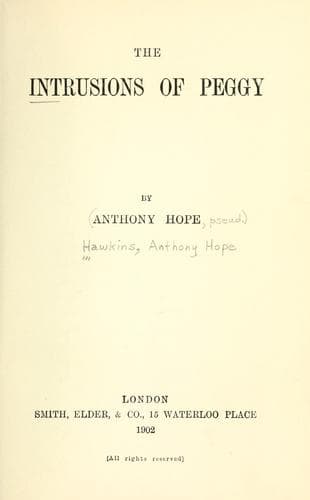
Female friendship -- Fiction; London (England) -- Social life and customs -- Fiction; Widows -- Fiction
Remembering her recklessness and her gaiety, recalling her
hardly-suppressed rebellion against the life he asked her to lead and
the air he gave her to breathe, rehearsing even the offences which had,
directly or indirectly, driven her to flight and entailed exile on her,
he found in her the embodiment of something that he condemned and yet
desired, of something that could not be contained in his life, and
thereby seemed in some sort to accuse that life of narrowness. She had
shown him a country which he could not and would not enter; at moments
the thought of her derisively beckoned him whither he could not go. At
last, under the influence of these ideas, which grew and grew as the
first shock of amazed resentment wore off, he came to put questions to
himself as to the part that he had played, to realise a little how it
had all seemed to her. This was not to blame himself or his part; he and
it were still to him right and inevitable. But it was a step towards
perceiving something deeper than the casual perversity or dishonesty of
one woman. He had inklings of an ultimate incompatibility of lives, of
ways, of training, of thought, of outlook on the world. Both she and he
had disregarded the existence of such a thing. The immediate causes of
her flight--her dishonesty and her fear of discovery--became, in this
view, merely the occasion of it. In the end he asked whether she had not
shown a kind of desperate courage, perhaps even a wild inspiration of
wisdom, in what she had done. Gradually his anger against her died away,
and there came in its place a sorrow, not that the thing she fled from
was not to be, but that it never could have been in any true or adequate
sense. Perhaps she herself had seen that--seen it in some flashing
vision of despair which drove her headlong from the house by night.
Feelings that Trix could not analyse for herself he thought out for her
with his slow, narrow, but patient and thorough-going mind. The task was
hard, for wounded pride still cried out in loud protest against it; but
he made way with it. If he could traverse the path of it to the end,
there stood comprehension, yes, and acquiescence; then it would appear
that Trix Trevalla had refused to pile error on error; in her blind way
she would have done right.
That things we have desired did not come to pass may be sad; that they
never could have is sadder, by so much as the law we understand seems a
more cruel force than the chance that hits us once, we know not whence,
and may never strike again. The chance seems only a perverse accident
falling on us from outside; the law abides, a limitation of ourselves.
Towards such a consciousness as this Mervyn struggled.
Public-domain text, read in full here on John Shaqi.
Reviews
Reviews
No reviews yet
Be the first to share your thoughts on this work.
Elsewhere in the archive
Join the Discussion
Join the discussion
Sign in to leave a comment or review.
Sign InorCreate an account