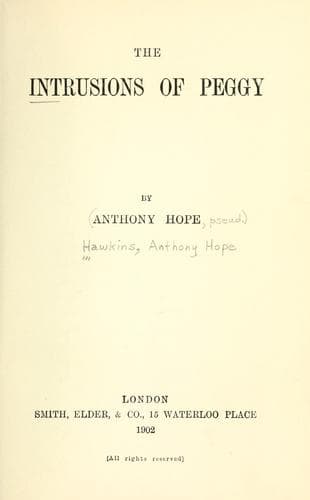
Female friendship -- Fiction; London (England) -- Social life and customs -- Fiction; Widows -- Fiction
'I've got off cheaply,' she thought; her own sufferings were not in her
mind, but his; she was glad that her burden of guilt was no heavier. For
Mervyn was not as Beaufort Chance; he had done nothing to make her feel
that they were quits and her wrong-doing obliterated by the revenge
taken for it. She could blame herself less, since even Mervyn seemed to
see that, if to begin had been criminal, to go on would have been worse.
But bitterness was still in her; her folly seemed still so black, her
ruin so humiliating, that she must cry, 'Unfit for him! No, it's for any
man that I'm unfit!' Mervyn could but comfort her a little as to what
concerned himself; her sin against herself remained unpardoned. And now
in her mind that sin had taken on a darker colour; since she had looked
in Airey Newton's eyes she could not believe herself the woman who had
done such things. The man who, having found the pearl, went and sold all
that he had and bought the field where it lay, doubtless did well and
was well-pleased. What did the vendor feel who bartered his right for a
small price because he had overlooked the pearl?
Mervyn showed her reply to Lady Blixworth--another proof that Aunt Viola
was advancing in his confidence, and repressing natural emotions with a
laudable devotion to duty. Upon this Lady Blixworth wrote to Peggy
Ryle:--
'This letter is not,' she said, 'to praise myself, Peggy, nor to point
out my many virtues, but to ask a question. I have indeed done much
good. Mortimer is convinced that immutable laws were in fault--and I
agree, since the dulness of Barslett and the family preachiness are
absolutely immutable. Trix is convinced too--and again I agree, since
Trix is naturally both headlong and sincere, an awful combination if
one were married to Mortimer. So I praise myself for having made both of
them resigned, and presently to be cheerful! Needless to say, I praise
myself on another score, and am backing myself to mother young women
against Sarah Bonfill herself (who, by the way, is here, and resettles
the Cabinet twice a day--mere bravado, I believe, after her shocking
blunders, but Sarah bravadoes with a noble solidity that makes the thing
almost a British quality!). I wander! What I really ask--and I want to
ask it in italics--is, _Whom is she in love with?_ Trix, I mean, of
course. I am not in telegraphic, telephonic, or telepathic communication
with her, but she says in her letter to Mortimer, "I was not fit for
you. Am I fit for any man?" My dear, believe your elders when you can,
and listen in silence when you can't! In all my experience I never knew
a woman ask that question unless she was in love. Heavens, do we want to
be fit for or to please the Abstract Man? Not a bit of it, Peggy! The
idea is even revolting, as a thousand good ladies would prove to you.
"Am I fit for any man?" Who's "any man," Peggy? Let's have his name and
the street where he resides. For my part, I believed there was a man at
Public-domain text, read in full here on John Shaqi.
Reviews
Reviews
No reviews yet
Be the first to share your thoughts on this work.
Elsewhere in the archive
Join the Discussion
Join the discussion
Sign in to leave a comment or review.
Sign InorCreate an account