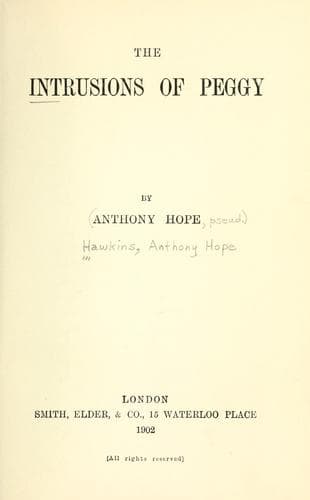
Female friendship -- Fiction; London (England) -- Social life and customs -- Fiction; Widows -- Fiction
To subtract instead of adding, to divide instead of multiplying, to
lessen after increase, to draw out instead of paying in--these
operations, whether with regard to a man's fame, or his power, or his
substance, or even the scope of his tastes and the joy of his
recreations, are precisely those which philosophy assumes to teach us to
perform gracefully and with no exaggerated pangs. The man himself
remains, says popular philosophy; and the pulpit sometimes seconds the
remark, adding thereunto illustrative texts. Consolations conceived in
this vein are probably useful, even though they may conceal a fallacy or
succeed by some pious fraud on the truth. It is a narrow view of a man
which excludes what he holds, what he has done and made. If he must lose
his grasp on that, part of his true self goes with it. The better
teachers inculcate not throwing away but exchange, renunciation here for
the sake of acquisition there, a narrowing of borders on one side that
there may be strength to conquer fairer fields on the other. Could Airey
Newton, who had so often turned in impatience or deafness from the first
gospel, perceive the truth of the second? He was left to fight for
that--left between the red book and the memory of Trix Trevalla.
But Trix went home on feet lighter than had borne her for many a day.
To her nature hope was ever fact, or even better--richer, wider, more
brightly coloured. Airey had given her hope. She swung back the baize
door of Peggy's flat with a cheerful vigour, and called aloud:--
'Peggy, where are you? I've something to tell you, Peggy.'
For once Peggy was there. 'I'm changing my frock,' she cried from her
room in a voice that sounded needlessly prohibitory.
'I want to tell you something,' called Trix. 'I've been to Airey
Newton's----'
Peggy's door flew open; she appeared gownless; her brush was in her
hand, and her hair streamed down her back.
'Oh, your hair!' exclaimed Trix--as she always did when she saw it thus
displayed.
Peggy's scared face showed no appreciation of the impulsive compliment.
'You've been to Airey's, and you've something to tell me?' she said,
scanning Trix with unconcealed anxiety.
But Trix did not appear to be in an accusing mood; she had no charge of
broken faith to launch, or of confidence betrayed.
'I told him how I stood--that I was pretty well ruined,' she explained,
'and he was so kind about it. And what do you think?' She paused for
effect. Peggy had recourse to diplomacy; she flung her masses of hair to
and fro, passing the brush over them in quick dexterous strokes as they
went.
'Well?' she asked, with more indifference than was even polite, much
less plausible.
But Trix noticed nothing; she was too full of the news.
'He told me there was a glimmer of hope for Glowing Stars!'
'He said that?'
Peggy's voice now did full justice to the importance of the tidings.
'Yes, hope for Glowing Stars. Peggy, if it should come out right!'
Public-domain text, read in full here on John Shaqi.
Reviews
Reviews
No reviews yet
Be the first to share your thoughts on this work.
Elsewhere in the archive
Join the Discussion
Join the discussion
Sign in to leave a comment or review.
Sign InorCreate an account