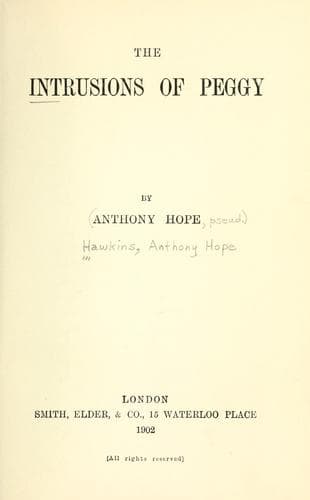
Female friendship -- Fiction; London (England) -- Social life and customs -- Fiction; Widows -- Fiction
'It's all right, mamma.' Her assurance was jovially impudent. 'I can do
just what I like with him!'
'You'll have a job sometimes,' opined Mrs. Fricker.
'That's half the fun.' She thought a moment, and then spoke with a
startling candour--with an unceremoniousness which Mrs. Fricker would
have reproved twenty-four hours earlier. 'I'm very fond of him,' she
said, 'but Beaufort's a funk in the end, you know.' She swung herself
off to bed, singing a song. Her title to triumph is not to be denied.
Peggy Ryle had furnished the opportunity, but the use of it had been all
her own. A natural exultation may excuse the exclamation with which she
jumped into bed:
'I knew Mrs. Trevalla wouldn't be in it if I got a fair show!'
Beaufort Chance stayed a while alone in the drawing-room before he went
down to join Fricker over a cigar. He had enjoyed Connie's company that
night; the truth stood out undeniable. She had made him forget what her
company meant and would cost--nay, more, what it would bring him in
worldly gain. She had made him forget, or cease to wish for, Trix
Trevalla. She had banished the thought of what he had been and once had
hoped to be. If she could do that for him, would he be unhappy? For a
moment he almost prayed to be always unhappy in the thing which he was
now set to do. For after an hour of blindness there came, as often, an
hour of illumination almost unnatural. In the light of it he saw one of
the worst things that a man can see. Enough of his old self and of his
old traditions remained to make his eyes capable of the vision. He knew
that the worst in him had been pleased; he saw that to please the worst
in him threatened now to become enough. His record was not very good,
but had he deserved this? It is useless to impugn the way of things. The
knowledge came to him that, as he had more and more sought the low and
not the high, so more and more the low had become sufficient to him. The
knowledge was very bitter; but with a startled horror he anticipated the
time when he would lose it. He had lost so much--public honour, private
scruples, delicacy of taste. He had set out with at least a respect for
these things and with that share in them which the manner of his life
and the standard of his associates imparted to him. They were all gone.
He was degraded. He knew that now, and he feared that even the
consciousness of it would soon die.
There was no help for it. In such cases there is none, unless a man will
forsake all and go naked into the wilderness. To such a violent remedy
he was unequal. It did not need Fricker's smooth assumption that all was
settled to tell him that all was settled indeed. It did not need
Fricker's welcome to the bosom of the family to tell him that of that
family he would now be. Fricker's eulogy of his daughter was
unnecessary, since soon to Beaufort too she would seem a meet subject
for unstinted praise.
Yet Fricker did not lack some insight into his thoughts.
Public-domain text, read in full here on John Shaqi.
Reviews
Reviews
No reviews yet
Be the first to share your thoughts on this work.
Elsewhere in the archive
Join the Discussion
Join the discussion
Sign in to leave a comment or review.
Sign InorCreate an account