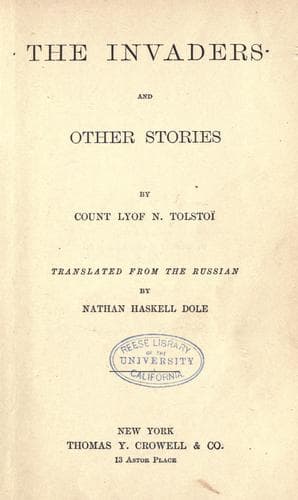
Russian fiction -- Translations into English; Short stories, Russian -- Translations into English
The recruit did not seem to notice any one, but had the consciousness
that an admiring public was attracted by his antics, and this gave him
strength and ability. He danced dexterously. His forehead was wrinkled,
his ruddy face was motionless, his mouth was parted in a smile which
had long lost all expression. It seemed as though all the energies of
his soul were directed to making one leg follow the other with all
possible swiftness, now on the heel and now on the toe. Sometimes he
would suddenly stop, and signal to the accompanist, who would instantly
begin to thrum on all the strings, and even to rap on the back of
the instrument with his knuckles. The recruit stopped, but even when
he stopped still, he seemed, as it were, to be all the time dancing.
Suddenly he began to slacken his pace, shrugging his shoulders, and,
leaping into the air, landed on his heels, and with a wild shriek set
up the Russian national dance.
The lads laughed, the women shook their heads, the lusty peasants
smiled with satisfaction. An old non-commissioned officer stood calmly
near the dancer with a look that said, "To you this is wonderful, but
to _us_ it's an old story." The balaláïka-player stood up in plain
sight, surveyed the crowd with a cool stare, struck a false chord, and
suddenly rapped his fingers on the back, and the dance was done.
"Hey! Alyókha," cried the accompanist to the dancer, and pointed to
Dutlof. "Isn't that your sponsor?"
"Where? O my dearly beloved friend!" screamed the recruit,--the same
one whom Dutlof had bought,--and stumbling out on his weary feet, and
lifting his jug of vodka above his head, he made for the team. "Mishka!
waiter! a glass," he shouted. "Master! O my dear old friend! How glad
I am! fact!" he went on, jerking his tipsy head towards the telyéga,
and began to treat the muzhíks and the women to vodka. The muzhíks
accepted, the women declined. "You are darlings, why shouldn't I treat
you?" cried the recruit, throwing his arms around the old women.
A woman peddling eatables was standing in the throng. The recruit saw
her, grabbed her tray, and flung its contents into the telyéga.
"D-don't worry, I'll p-pay--the d-deuce," he began to scream in a
drunken voice; and here he drew out of his stocking a purse with money
in it, and flung it to the waiter.
He stood leaning with his elbows on the wagon, and stared, with moist
eyes, at those who sat in it.
"Which is my mátushka?" he asked. "Be you her? I've got something for
her too."
He pondered a moment, and diving into his pocket brought out a new
handkerchief folded, untied another which he had put on as a girdle
under his coat, hastily took the red scarf from his neck, bundled them
together, and thrust them into the old woman's lap.
"Na! I give 'em to you," he said, in a voice that grew weaker and
weaker.
"Why? thank you, friend!--What a simple lad he is!" said she,
addressing the old man Dutlof, who came up to their telyéga.
Public-domain text, read in full here on John Shaqi.
Reviews
Reviews
No reviews yet
Be the first to share your thoughts on this work.
Elsewhere in the archive
Join the Discussion
Join the discussion
Sign in to leave a comment or review.
Sign InorCreate an account