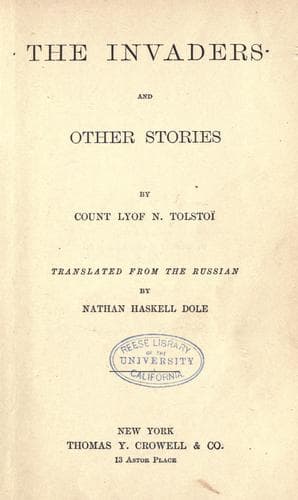
Russian fiction -- Translations into English; Short stories, Russian -- Translations into English
about the expedition, about the fatherland, or about their chiefs.
As I came around one of the tents of the third battalion, I heard
Guskof's rough voice: he was speaking hilariously and rapidly. Young
voices replied to him, not those of soldiers, but of gay gentlemen.
It was evidently the tent of some yunker or sergeant-major. I stopped
short.
"I've known him a long time," Guskof was saying. "When I lived in
Petersburg, he used to come to my house often; and I went to his. He
moved in the best society."
"Whom are you talking about?" asked a drunken voice.
"About the prince," said Guskof. "We were relatives, you see, but, more
than all, we were old friends. It's a mighty good thing, you know,
gentlemen, to have such an acquaintance. You see, he's fearfully rich.
To him a hundred silver rubles is a mere bagatelle. Here, I just got a
little money out of him, enough to last me till my sister sends."
"Let's have some."
"Right away.--Savelitch, my dear," said Guskof, coming to the door
of the tent, "here's ten rubles for you: go to the sutler, get two
bottles of Kakhetinski. Any thing else, gentlemen? What do you say?"
and Guskof, with unsteady gait, with dishevelled hair, without his hat,
came out of the tent. Throwing open his jacket, and thrusting his hands
into the pockets of his trousers, he stood at the door of the tent.
Though he was in the light, and I in darkness, I trembled with fear
lest he should see me, and I went on, trying to make no noise.
"Who goes there?" shouted Guskof after me in a thoroughly drunken
voice. Apparently, the cold took hold of him. "Who the devil is going
off with that horse?"
I made no answer, and silently went on my way.
[Footnote 1: _gorodki._]
[Footnote 2: _denshchiki._]
[Footnote 3: _nu chto, bátenka._]
[Footnote 4: _polushúbok,_ little half _shuba,_ or fur cloak.]
[Footnote 5: _bátenka,_ Malo-Russian diminutive, little father.]
[Footnote 6: _papírósotchka,_ diminished diminutive of _papiróska,_
from _papiros_.]
[Footnote 7: _bátenka._]
[Footnote 8: _stranno._]
[Footnote 9: _bátenka moï._]
[Footnote 10: _Oui, mon cher, lea jours se suivent, mais ne se
ressemblent pas:_ in French in the original.]
[Footnote 11: _bátiushka._]
[Footnote 12: _On me verra au feu._]
[Footnote 13: _Ce que j'ai eu à souffrir vous ne vous faites pas une
idée._]
[Footnote 14: _Avec les petits moyens que j'avais, je manquais de
tout._]
[Footnote 15: "_Avez-vous un papiros?_"]
[Footnote 16: _On m'a vu au feu._]
[Footnote 17: _Ça tue._]
[Footnote 18: _denshchik._]
[Footnote 19: _chikír._]
[Footnote 20: _Akh, Bozhe moï, Bozhe moï!_]
[Footnote 21: _Et je n'ai pas la tête forte._]
[Footnote 22: _blagorodstva,_ noble birth, nobility.]
[Footnote 23: _bátiushka._]
[Footnote 24: _váshe vuisokoblagorodïe._ German, _hochwohlgeborener,_
high-well born; regulation title of officers from major to general.]
LOST ON THE STEPPE; OR, THE SNOWSTORM.
_A TALE._
I.
Public-domain text, read in full here on John Shaqi.
Reviews
Reviews
No reviews yet
Be the first to share your thoughts on this work.
Elsewhere in the archive
Join the Discussion
Join the discussion
Sign in to leave a comment or review.
Sign InorCreate an account