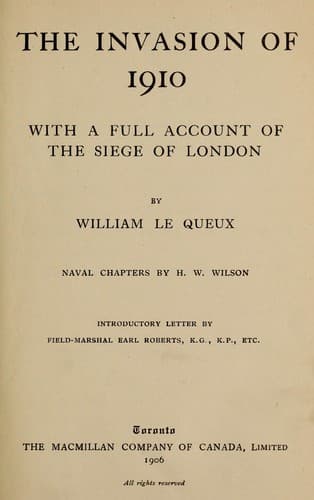
Great Britain -- Defenses; Imaginary wars and battles
Soon after dawn Von Kronhelm and his staff rode down Haverstock Hill
with a large body of cavalry, and made his formal entry into London,
first having an interview with the Lord Mayor, and an hour afterwards
establishing his headquarters at the new War Office in Whitehall, over
which he hoisted his special flag as Commander-in-Chief. It was found
that, though a good deal of damage had been done externally to the
building, the interior had practically escaped, save one or two rooms.
Therefore the Field Marshal installed himself in the private room of the
War Minister, and telegraphic and telephonic communication was quickly
established, while a wireless telegraph apparatus was placed upon the
ruined summit of Big Ben for the purpose of communicating with Germany,
in case the cables were interrupted by being cut at sea.
The day after the landing a similar apparatus had been erected on the
Monument at Yarmouth, and it had been daily in communication with the
one at Bremen. The German left nothing to chance.
The clubs in Pall Mall were now being used by German officers, who
lounged in easy chairs, smoking and taking their ease, German soldiers
being on guard outside. North of the Thames seemed practically deserted,
save for the invaders who swarmed everywhere. South of the Thames the
cowed and terrified populace were asking what the end was to be. What
was the Government doing? It had fled to Bristol and left London to its
fate, they complained.
What the German demands were was not known until the "Daily Telegraph"
published an interview with Sir Claude Harrison, the Lord Mayor, which
gave authentic details of them.
They were as follows:--
1. Indemnity of £300,000,000, paid in ten annual instalments.
2. Until this indemnity is paid in full, German troops to occupy
Edinburgh, Rosyth, Chatham, Dover, Portsmouth, Devonport,
Pembroke, Yarmouth, Hull.
3. Cession to Germany of the Shetlands, Orkneys, Bantry Bay,
Malta, Gibraltar, and Tasmania.
4. India, north of a line drawn from Calcutta to Baroda, to be
ceded to Russia.
5. The independence of Ireland to be recognised.
Of the claim of £300,000,000, fifty millions was demanded from London,
the sum in question to be paid within twelve hours.
The Lord Mayor had, it appeared, sent his secretary to the Prime
Minister at Bristol bearing the original document in the handwriting of
Von Kronhelm. The Prime Minister had acknowledged its receipt by
telegraph both to the Lord Mayor and to the German Field Marshal, but
there the matter had ended.
The twelve hours' grace was nearly up, and the German Commander, seated
in Whitehall, had received no reply.
In the corner of the large, pleasant, well-carpeted room sat a German
telegraph engineer with a portable instrument, in direct communication
with the Emperor's private cabinet at Potsdam, and over that wire
messages were continually passing and repassing.
Public-domain text, read in full here on John Shaqi.
Reviews
Reviews
No reviews yet
Be the first to share your thoughts on this work.
Elsewhere in the archive
Join the Discussion
Join the discussion
Sign in to leave a comment or review.
Sign InorCreate an account