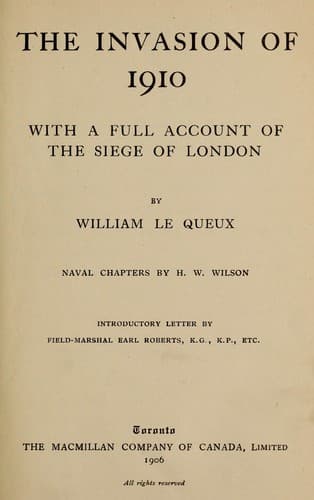
Great Britain -- Defenses; Imaginary wars and battles
"And this," he said, "is the only hope of England! The defence of London
by an armed mob, pitted against the most perfectly equipped and armed
force in the world! Londoners are patriotic, I grant. They will die
fighting for their homes, as every Englishman will when the moment
comes; yet, what can we hope, when patriotism is ranged against modern
military science? There surely is patriotism in the savage negro races
of Central Africa, a love of country perhaps as deep as in the white
man's heart; yet a little strategy, a few Maxims, and all defence is
quickly at an end. And so it must inevitably be with London. I contend,
Mr. Speaker," he went on, "that by the ill-advised action of the
Government from the first hour of their coming into power, we now find
ourselves conquered. It only remains for them now to make terms of peace
as honourable to themselves as the unfortunate circumstances will admit.
Let the country itself judge their actions in the light of events of
to-day, and let the blood of the poor murdered women and children of
London be upon their heads. (Shame.) To resist further is useless. Our
military organisation is in chaos, our miserably weak army is defeated
and in flight. I declare to this House that we should sue at this very
moment for peace--a dishonourable peace though it be; but the bitter
truth is too plain--England is conquered!"
As he sat down amid the "hear, hears," and the loud applause of the
Opposition there rose a keen-faced, dark-haired, clean-shaven man of
thirty-seven or so. He was Gerald Graham, younger son of an aristocratic
house, the Yorkshire Grahams, who sat for North-East Rutland. He was a
man of brilliant attainments at Oxford, a splendid orator, a
distinguished writer and traveller, whose keen brown eye, lithe upright
figure, quick activity, and smart appearance, rendered him a born leader
of men. For the past five years he had been marked out as a "coming
man."
As a soldier he had seen hard service in the Boer War, being mentioned
twice in despatches; as an explorer he had led a party through the heart
of the Congo and fought his way back to civilisation through an
unexplored land with valiant bravery that had saved the lives of his
companions. He was a man who never sought notoriety. He hated to be
lionised in society, refused the shoals of cards of invitation which
poured in upon him, and stuck to his Parliamentary duties, and keeping
faith with his constituents to the very letter.
As he stood up silent for a moment, gazing around him fearlessly, he
presented a striking figure and in his navy serge suit he possessed the
unmistakable cut of the smart, well-groomed Englishman who was also a
man of note.
The House always listened to him, for he never spoke without he had
something of importance to say. And the instant he was up a silence
fell.
Public-domain text, read in full here on John Shaqi.
Reviews
Reviews
No reviews yet
Be the first to share your thoughts on this work.
Elsewhere in the archive
Join the Discussion
Join the discussion
Sign in to leave a comment or review.
Sign InorCreate an account