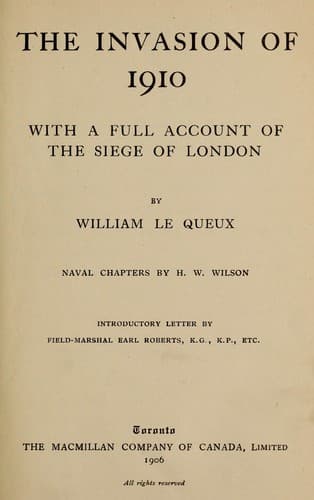
Great Britain -- Defenses; Imaginary wars and battles
The League of Defenders formed by Gerald Graham and his friends was,
however, working independently. The wealthier classes, who, driven out
of London, were now living in cottages and tents in various parts of
Berks, Wilts, and Hants, worked unceasingly on behalf of the League,
while into Plymouth, Exmouth, Swanage, Bristol, and Southampton more
than one ship had already managed to enter laden with arms and
ammunition of all kinds, sent across by the agents of the League in
France. The cargoes were of a very miscellaneous character, from modern
Maxims to old-fashioned rifles that had seen service in the war of 1870.
There were hundreds of modern rifles, sporting guns, revolvers,
swords--in fact, every weapon imaginable, modern and old-fashioned.
These were at once taken charge of by the local branches of the League,
and to those men who presented their tickets of identification the arms
were served out, and practice conducted in the open fields. Three
shiploads of rifles were known to have been captured by German warships,
one off Start Point, another a few miles outside Padstow, and a third
within sight of the coastguard at Selsey Bill. Two other ships were
blown up in the Channel by drifting mines. The running of arms across
from France and Spain was a very risky proceeding; yet the British
skipper is nothing if not patriotic, and every man who crossed the
Channel on those dangerous errands took his life in his hand.
Into Liverpool, Whitehaven, and Milford weapons were also coming over
from Ireland, even though several German cruisers, who had been up to
Lamlash to cripple the Glasgow trade, had now come south, and were
believed still to be in the Irish Sea.
CHAPTER VIII.
DEFENCES OF SOUTH LONDON.
Preparations were being continued night and day to place the
working-class districts in Southwark and Lambeth in a state of strong
defence, and the constant meetings convened in public halls and chapels
by the newly-formed League of Defenders incited the people to their
work. Everybody lent a willing hand, rich and poor alike. People who had
hitherto lived in comfort in Regent's Park, Hampstead, or one or other
of the better-class northern suburbs, now found themselves herded among
all sorts and conditions of men and women, and living as best they could
in those dull, drab streets of Lambeth, Walworth, Battersea, and
Kennington. It was, indeed, a strange experience for them. In the sudden
flight from the north, parents had become separated from their children
and husbands from their wives, so that in many cases haggard and forlorn
mothers were in frantic search of their little ones, fearing that they
might have already died of starvation or been trampled underfoot by the
panic-stricken multitudes. The dense population of South London had
already been trebled. They were penned in by the barricades in many
instances, for each district seemed to be now placing itself in a state
of defence, independent of any other.
Public-domain text, read in full here on John Shaqi.
Reviews
Reviews
No reviews yet
Be the first to share your thoughts on this work.
Elsewhere in the archive
Join the Discussion
Join the discussion
Sign in to leave a comment or review.
Sign InorCreate an account