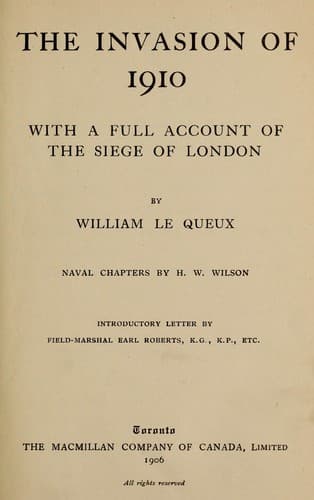
Great Britain -- Defenses; Imaginary wars and battles
A great poster headed "Englishmen," here reproduced, was seen
everywhere. The whole country was flooded with it, and thousands upon
thousands of heroic Britons, from the poorest to the wealthiest,
clamoured to enrol themselves. The movement was an absolutely national
one in every sense of the word. The name of Gerald Graham, the new
champion of England's power, was upon every one's tongue. Daily he spoke
in the various towns in the West of England, in Plymouth, Taunton,
Cardiff, Portsmouth, and Southampton, and, assisted by the influential
committee among whom were many brilliant speakers and men whose names
were as household words, he aroused the country to the highest pitch of
hatred against the enemy. The defenders, as they drilled in various
centres through the whole of the West of England, were a strange and
incongruous body. Grey-bearded Army pensioners ranged side by side with
keen, enthusiastic youths, advised them and gave them the benefit of
their expert knowledge. Volunteer officers in many cases assumed
command, together with retired drill sergeants. The digging of trenches
and the making of fortifications were assigned to navvies, bricklayers,
platelayers, and agricultural labourers, large bodies of whom were under
railway gangers, and were ready to perform any excavation work.
The Maxims and other machine guns were mostly manned by Volunteer
artillery; but instruction in the working of the Maxim was given to
select classes in Plymouth, Bristol, Portsmouth, and Cardiff. Time was
of utmost value, therefore the drilling was pushed forward day and
night. It was known that Von Kronhelm was already watchful of the
movements of the League, and was aware daily of its growth.
In London, with the greatest secrecy, the defenders were banding
together. In face of the German proclamation posted upon the walls,
Londoners were holding meetings in secret and enrolling themselves.
Though the German eagle flew in Whitehall and from the summit of St.
Stephen's Tower, and though the heavy tramp of German sentries echoed in
Trafalgar Square, in the quiet, trafficless streets in the vicinity,
England was not yet vanquished.
The valiant men of London were still determined to sell their liberty
dearly, and to lay down their lives for the freedom of their country and
honour of their King.
BOOK III.
THE REVENGE.
CHAPTER I.
A BLOW FOR FREEDOM.
"'DAILY TELEGRAPH' OFFICE.
"_Oct._ 1, 2 P.M.
Public-domain text, read in full here on John Shaqi.
Reviews
Reviews
No reviews yet
Be the first to share your thoughts on this work.
Elsewhere in the archive
Join the Discussion
Join the discussion
Sign in to leave a comment or review.
Sign InorCreate an account