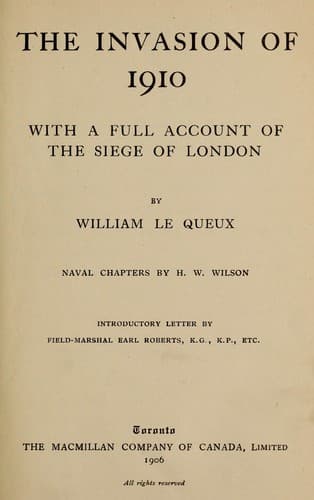
Great Britain -- Defenses; Imaginary wars and battles
"They realised that to do this he would have to sacrifice his men in
thousands upon thousands, but they knew that to do so would be his only
possible chance of success in this eventuality, since the bulk of his
men could neither manoeuvre nor deploy. Still they reckoned that in the
desperate situation of the British, he would make up his mind to do
this.
"On their part, although they fully realised the possibility of being
overwhelmed by such tactics, they felt pretty confident that, posted as
they were behind a perfect network of small rivers and streams which ran
down to join the Thames, they would at least succeed in beating off the
attack with heavy loss, and stood no bad chance of turning the repulse
into a rout by skilful use of Frölich's Cavalry Division, which would be
irresistible when attacking totally untrained troops after they had been
shattered and disorganised by artillery fire. This, at least, is the
view of those experts with whom I have spoken.
"What, perhaps, tended rather to confirm them in their theories as to
the action of the British was the rifle firing that went on along the
whole of their front all night through. The officers in charge of the
various units which conglomerated together formed the forces facing the
Saxons, had picked out the few men under their command who really had
some little idea of using a rifle, and, supplied with plenty of
ammunition, had sent them forward in numerous small parties with general
orders to approach as near the enemy's picket line as possible, and as
soon as fired on to lie down and open fire in return. So a species of
sniping engagement went on from dark to dawn. Several parties got
captured or cut up by the German outlying troops and many others got
shot by neighbouring parties of snipers. But, although they did not in
all probability do the enemy much damage, yet they kept them on the
alert all night, and led them to expect an attack in the morning. One
way and another luck was entirely on the side of the patriots that
morning.
"When daylight came the British massed to the westward of Staines had
such a threatening appearance from their immense numbers, and their fire
from their batteries of heavy guns and howitzers on the south side of
the river, which took the German left flank in, was so heavy that Prince
Henry, who was there in person, judged an attack to be imminent, and
would not spare a man to reinforce his troops at Shepperton and
Halliford, who were, numerically, totally inadequate to resist the
advance of the British once they got across the river.
Public-domain text, read in full here on John Shaqi.
Reviews
Reviews
No reviews yet
Be the first to share your thoughts on this work.
Elsewhere in the archive
Join the Discussion
Join the discussion
Sign in to leave a comment or review.
Sign InorCreate an account