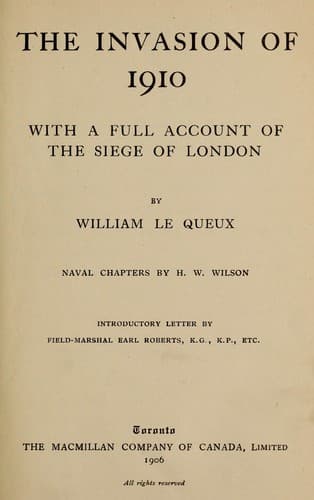
Great Britain -- Defenses; Imaginary wars and battles
"Here disaster befell them. A battery of 4.7 guns was suddenly unmasked
on Richmond Hill, and, firing at a range of 5,000 yards, played havoc
with the marching column. The head of it also suffered severe loss from
riflemen concealed in Kew Gardens, and the whole force had to extend and
fall back for some distance in a northerly direction. Near Ealing they
met the Uxbridge brigade, and a certain delay and confusion occurred.
However, trained soldiers such as these are not difficult to reorganise,
and while the latter continued its march along the main road the
remainder moved in several small parallel columns through Acton and
Turnham Green. Before another half-hour had elapsed there came a sound
of firing from the advanced guard. Orders to halt followed, then orders
to send forward reinforcements.
"During all this time the rattle of rifle fire waxed heavier and
heavier. It soon became apparent that every road and street leading into
London was barricaded and that the houses on either side were crammed
with riflemen. Before any set plan of action could be determined on, the
retiring Saxons found themselves committed to a very nasty bout of
street fighting. Their guns were almost useless, since they could not be
placed in positions from which they could fire on the barricades except
so close as to be under effective rifle fire. They made several
desperate assaults, most of which were repulsed. In Goldhawk Road a
Jäegar battalion contrived to rush a big rampart of paving-stones which
had been improvised by the British; but, once over, they were decimated
by the fire from the houses on either side of the street. Big high
explosive shells from Richmond Hill, too, began to drop among the
Saxons. Though the range was long, the gunners were evidently well
informed of the whereabouts of the Saxon troops and made wonderfully
lucky shooting.
"For some time the distant rumble of the firing to the south-west had
been growing more distinct in their ears, and about four o'clock it
suddenly broke out comparatively near by. Then came an order from Prince
Henry to fall back on Ealing at once. What had happened? It will not
take long to relate this. Prince Henry's covering position had lain
roughly between East Bedfont and Hounslow, facing south-east. He had
contrived to hold on to the latter place long enough to allow his right
to pivot on it and fall back to Cranford Bridge. Here they were, to a
certain extent, relieved from the close pressure they had been subjected
to by the constantly advancing British troops, by the able and
determined action of Frölich's Cavalry Brigade.
Public-domain text, read in full here on John Shaqi.
Reviews
Reviews
No reviews yet
Be the first to share your thoughts on this work.
Elsewhere in the archive
Join the Discussion
Join the discussion
Sign in to leave a comment or review.
Sign InorCreate an account