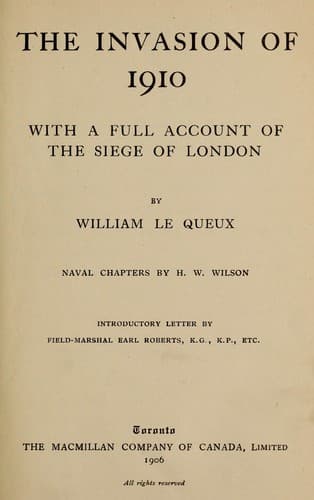
Great Britain -- Defenses; Imaginary wars and battles
"The naval news of the past few days may be briefly summarised. The
British main fleet entered the North Sea, and our submarines did most
excellent work in the neighbourhood of the Maas Lightship. Prince
Stahlberger had concentrated practically the whole of his naval force
off Lowestoft, but a desperate battle was fought about seventy miles
from the Texel, full details of which are not yet to hand. All that is
known is that, having now regained command of the sea, we were enabled
to inflict a crushing defeat upon the Germans, in which the German
flagship was sunk. In the end sixty-one British ships were concentrated
against seventeen German, with the result that the German fleet has
practically been wiped out, there being 19,000 of the enemy's officers
and men on the casualty list, the greatest recorded in any naval battle.
"Whatever may be the demands for indemnity on either side, one thing is
absolutely certain, namely, that the invincible German Army and Navy are
completely vanquished. The Eagle's wings are trailing in the dust."
CHAPTER V.
HOW THE WAR ENDED.
Days passed--weary, waiting, anxious days. A whole month went by. What
had really happened at sea was unknown. After the truce, London very
gradually began to resume her normal life, though the gaunt state of the
streets was indescribably weird.
Shops began to open, and as each day passed, food became more plentiful
and consequently less dear. The truce meant the end of the war,
therefore thanksgiving services were held in every town and village
throughout the country.
There were great prison-camps of Germans at Hounslow, Brentwood, and
Barnet, while Von Kronhelm and his chief officers were also held as
prisoners until some decision through diplomatic channels could be
arrived at. Meanwhile a little business began to be done; thousands
began to resume their employment, bankers reopened their doors, and
within a week the distress and suffering of the poor became perceptibly
alleviated. The task of burying the dead after the terrible massacre of
the Germans in the London streets had been a stupendous one, but so
quickly had it been accomplished that an epidemic was happily averted.
Parliament moved back to Westminster, and daily meetings of the Cabinet
were being held in Downing Street. These resulted in the resignation of
the Ministry, and with a fresh Cabinet, in which Mr. Gerald Graham, the
organiser of the Defenders, was given a seat, a settlement was at last
arrived at.
To further describe the chaotic state of England occasioned by the
terrible and bloody war would serve no purpose. The loss and suffering
which it had caused the country had been incalculable; statisticians
estimated that in one month of hostilities it had amounted to
£500,000,000, a part of which represented money transferred from British
pockets to German, as the enemy had carried off some of the securities
upon which the German troops had laid their hands in London.
Public-domain text, read in full here on John Shaqi.
Reviews
Reviews
No reviews yet
Be the first to share your thoughts on this work.
Elsewhere in the archive
Join the Discussion
Join the discussion
Sign in to leave a comment or review.
Sign InorCreate an account