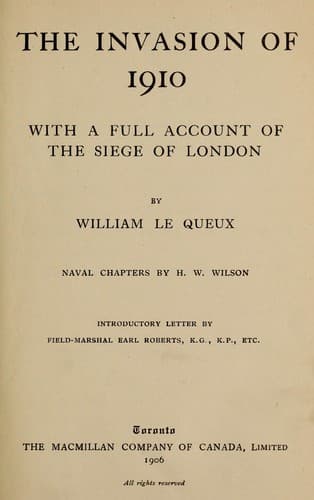
Great Britain -- Defenses; Imaginary wars and battles
The United Kingdom, indeed, might have been reduced to absolute
starvation had it not been for the fact that the Canadian Government
interfered in Canada to prevent similar German tactics from succeeding,
and held the German contracts for the cornering of Canadian wheat,
contrary to public policy.
The want of food, the high price of bread and meat in England, and the
greatly increased cost of the supplies of raw material sent up the
expenditure upon poor relief to enormous figures. Millions of men were
out of employment, and in need of assistance. Mills and factories in
all directions had closed down, either because of the military danger
from the operations of the German armies, or because of the want of
orders, or, again, because raw materials were not procurable.
Unfortunately, when the invasion began, many rich foreigners who had
lived in England collected what portable property they possessed and
retired abroad to Switzerland, Italy, and the United States. Their
example was followed by large numbers of British subjects who had
invested abroad, and now, in the hour of distress, were able to place
their securities in a handbag and withdraw them to happier countries.
They may justly be blamed for this want of patriotism, but their reply
was that they had been unjustly and mercilessly taxed by men who derided
patriotism, misused power, and neglected the real interests of the
nation in the desire to pander to the mob. Moreover, with the income-tax
at 3_s._ 6_d._ in the pound, and with the cost of living enormously
enhanced, they declared that it was a positive impossibility to live in
England, while into the bargain their lives were exposed to danger from
the enemy.
As a result of this wholesale emigration, in London and the country the
number of empty houses inordinately increased, and there were few
well-to-do people left to pay the rates and taxes. The fearful burden of
the extravagant debts which the British municipalities had heaped up was
cruelly felt, since the nation had to repudiate the responsibility which
it had incurred for the payment of interest on the local debts. The
Socialist dream, in fact, might almost be said to have been realised.
There were few rich left, but the consequences to the poor, instead of
being beneficial, were utterly disastrous.
Under the pressure of public opinion, constrained by hunger and
financial necessities, and with thousands of German prisoners in their
hands, the British Government acceded to the suggested conference to
secure peace.
* * * * *
Peace was finally signed on January 13, 1911. The British Empire emerged
from the conflict outwardly intact, but internally so weakened that only
the most resolute reforms accomplished by the ablest and boldest
statesmen, could have restored it to its old position.
Public-domain text, read in full here on John Shaqi.
Reviews
Reviews
No reviews yet
Be the first to share your thoughts on this work.
Elsewhere in the archive
Join the Discussion
Join the discussion
Sign in to leave a comment or review.
Sign InorCreate an account