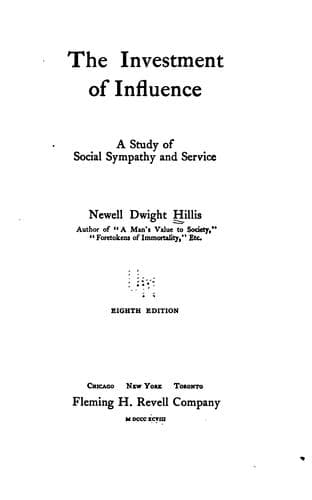
The Investment of Influence: A Study of Social Sympathy and ServiceHillis, Newell Dwight
Philosophy
The Investment of Influence: A Study of Social Sympathy and Service
Hillis, Newell Dwight
Conduct of life
Nor is scholarship enough. From Solomon to Burke, the wisest men have
been the saddest of men. The Scottish physician who ordered his
secretary to select from his library all the books upon medicine and
surgery that were printed prior to 1880 and sell them, tells us how
futile is the pursuit of wisdom and how rapidly the systems of to-day
become the cast-off garments of to-morrow. Nor must the perfect man
represent power and wealth alone, for "the wealth of Croesus cannot
bring sleep to the sick man tossing upon his silken couch, and all the
Alexanders and Napoleons have shed bitter tears, conquering or
conquered." He who is merchant or scholar or ruler, and only that,
climbs his pillar like Simeon Stylites.
All such know not that the world itself is a pillar all too small for
the soul to stand upon. This life-chase after bubbles, this fighting
for trifles, this pursuit of false grails, reminds us of the story of
that Grecian boy lured to his death by the enchantress. Going into the
palace garden to pluck a rose, the youth beheld the form of a young
girl standing in the edge of the glimmering woods. With soft words and
sweet, she called him. Forgetting his dear ones in the palace, the
youth ran after his enchantress. Along a pathway of flowers she danced
before him, sometimes sweeping the strings of her harp, sometimes
singing, and shaking her curls at his haste, ever shooting arrows from
her eyes, yet ever just eluding his embrace. On and on she led him
into the bog, that covered his garments with mud, through the thorns
and brambles that tore his white skin, over rocks steep and sharp.
Ever and anon the youth stopped to pluck the thorns from his hands and
bind up his bleeding feet; then, gathering his torn purple about him,
he plunged on, in the hope of drinking at last the sweet cup of her
sorcery. When, at the end of the day, the desire of his heart was
given him, the illusion fell away, for the youth embraced not a
beautiful maiden, but an old hag, who had led him into the desert to a
hut whose stones were darkness and whose walls were confusion.
As the term genius includes all those forms of culture termed poetry,
music, eloquence, leadership, so love is a term that includes all those
shapes of human welfare known as education, refinement, liberty,
happiness. Properly defined, love is that exalted state of mind and
heart when reason is luminous, when judgment and imagination glow under
its influence just as the electric bulb glows under the living current.
There are three possible states and moods under which the mind may
fulfill its functions. There is a dull and quiescent condition when
reason and judgment act, but act without fervor. Power is there, but
it is latent, just as heat is in the unkindled wood lying on the grate,
but the heat is hidden.
Public-domain text, read in full here on John Shaqi.
Reviews
Reviews
No reviews yet
Be the first to share your thoughts on this work.
Elsewhere in the archive
Join the Discussion
Join the discussion
Sign in to leave a comment or review.
Sign InorCreate an account