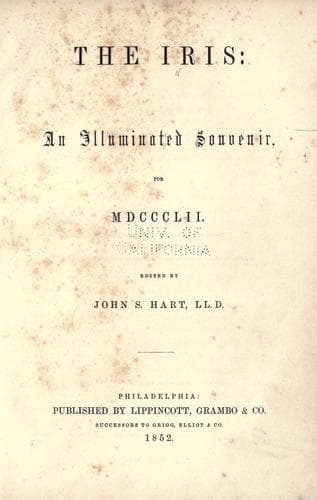
Gift books; Indians of North America -- Literary collections
"Run--use your rebel soldier legs--
Tell General Washington.
Don't wait--you'll be promoted for't--
I'll stand and hold your gun."
Out spake the guard--"You British crow,
Curse on your croaking head!
Move off, or else, I swear, you'll get
The cartridge and the lead."
2.
Full of his news, the sentry soon
To Knowlton told the same.
Knowlton, with tears in either eye,
To the head-quarters came,
And told to General Washington
Poor Hale's unhappy case.
Nought answered he, but bowed awhile,
With hands upon his face.
Then rising, steadfast and serene,
The same great master still--
Curbing a noble sorrow down
With a more noble will--
"Bring me," said he, "my writing-desk,
And maps last night begun;
Send hither Putnam, Lee, and Greene,
For much is to be done."
So perished Nathan Hale. God grant
Us not to die as he;
But, for the glorious Stripes and Stars,
Such iron loyalty.
NOTE.--Nathan Hale was a native of the town of Coventry, in
Connecticut; and graduated at Yale College, in 1773. He entered the
army of the Revolution at an early period, as a captain in a light
infantry regiment, under command of Colonel Knowlton. After the
defeat of the 27th August, 1776, and the retreat of the Americans
from Long Island, Washington became exceedingly desirous to gain
some information respecting the future operations of the enemy, and
applied to Colonel Knowlton, through whom Hale was introduced, and
volunteered his services.
He disguised himself, crossed to Long Island, procured admission to
the British camp, obtained the information desired, and was about
leaving the Island, when a refugee and a relative recognised, and
betrayed him.
The case was clear. Hale confessed; and Sir William Howe ordered
him hung the next morning. He suffered like a patriot and a
Christian. "I lament," said he, "that I have but one life to
lose for my country." The provost-marshal, who superintended the
execution, was a savage-hearted man, and refused him the attendance
of a clergyman, and the use of a Bible, and destroyed letters which
he had written to his mother, and other friends, making the remark,
that "the rebels should not know that they had a man in their army
who could die with so much firmness."
An aged physician, recently deceased, was accustomed to relate an
anecdote that is worthy of preservation. The Doctor, when a small
boy, attended a school taught by Hale in the town of East Windsor,
Connecticut. One day Hale was standing at his desk, in a deep
study, when certain wide-awake boys began to take advantage of his
inattention.
Public-domain text, read in full here on John Shaqi.
Reviews
Reviews
No reviews yet
Be the first to share your thoughts on this work.
Elsewhere in the archive
Join the Discussion
Join the discussion
Sign in to leave a comment or review.
Sign InorCreate an account