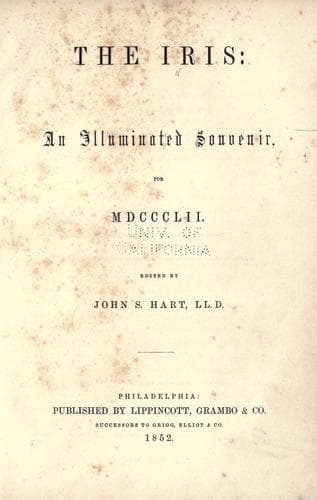
Gift books; Indians of North America -- Literary collections
On the day of the child's death she had been obliged to leave her work,
to go out at some little distance to cut wood. She did not, as usual,
take her child with her: it was asleep in its carved board cradle,
and she left it in charge of a girl, the child of one of her friends.
Fiery Man's sister had gone out, telling White Moon she should be away
all day. So great was her dread of this proud woman--so fearful was
she that she would revenge on her child the hatred she felt towards
herself--that otherwise she would not have left the infant at home.
The anticipations of White Moon at her first interview with her
husband's sister were all realized. This woman possessed all the bad
qualities of Fiery Man, without any of his redeeming ones.
She had been married, and was a widow. Both of her children were dead:
there was no avenue by which kindness could find its way to her heart.
She disliked White Moon, because she had so won her brother's love. But
there needed to assign no reason, for she disliked all who were better
off than she.
It is not only in civilized life that the dread passion of envy
has full sway: the human heart, the same by nature, varies only by
association and circumstance.
Had it not been for the unhappy disposition of Fiery Man's sister,
White Moon had been happy. She could not but be proud of her husband,
and of his affection for her: it was not in the nature of a Sioux woman
to see unmoved the many trophies of his skill and bravery. But the
curse of envy was about her; and when White Moon smiled over her boy,
and Fiery Man exulted in the pride and affection of a Sioux father for
his son, his sister could not rejoice with them--she envied and hated
them.
Fiery Man exacted the most implicit obedience from his wife, and from
all around him. He would not have brooked the slightest contradiction
from her; but she did not attempt it.
In most cases an Indian wife is little more than a serving-woman to
her husband. To this White Moon was accustomed from observation,
and from her short experience. She trembled at her husband's voice,
though against her it had never been raised in anger. But the violent
passions, the abusive language, the frequent blows--these, coming from
one who ought to have no power over her, made her often wish for death.
Yet so great was the likeness of brother and sister, that she bowed to
the tyranny of the one, from having done so to the other. Her spirit,
too, was broken. She could easily submit, but not forget. When she left
her child in the wigwam it was quietly sleeping; when she returned it
still slept. She had been a long time away, and yet the rest of the
infant appeared to have been unbroken.
She missed the girl who had promised to remain with the child. She had
brought a heavy burden of wood to her lodge, and she sat down by the
child to rest, and to watch its awakening.
Public-domain text, read in full here on John Shaqi.
Reviews
Reviews
No reviews yet
Be the first to share your thoughts on this work.
Elsewhere in the archive
Join the Discussion
Join the discussion
Sign in to leave a comment or review.
Sign InorCreate an account