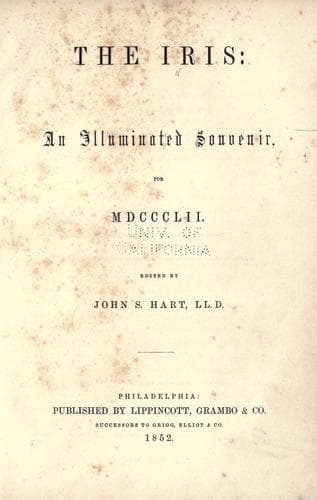
Gift books; Indians of North America -- Literary collections
Then came back the colour to the bronzed cheek of Fiery Man, and the
flashing to his eye. Then did he stand erect, like one that had never
known grief--then did love change to bitter hatred. The wife of his
bosom was his worst enemy. There were no more tears, but loud threats
of vengeance--no trembling, but firm purposes of revenge.
He went again to the lodge, to look at his sister's body. He left her,
and stood by the grave of his child. He laid his hand upon the little
body, and stood thus while he decided what to do. He shouted for the
young men, and told them to go and hunt for his wife, and bring her
back to him.
It was fearful to see the paroxysms of his hot anger. He lay down on
the grass near his child; he rested, but not with sleep. He sought his
wife through the night, but in vain. He went into the thick forests;
he remembered Chat-o-tee-dah, the god of the woods, was his friend; he
prayed to the god; he sacrificed to the wakeen-stone; but still he was
unsuccessful.
He knew neither sleep nor rest until the evening of the next day, when
he was forced to yield to his overtaxed condition. There did he stand,
by the Laughing Waters, where she had stood. The White Moon was making
her way, slowly and sadly, but clinging to life--full of grief, but
fearing the avenger--living on the berries of the woods, and sleeping
where the red deer and its young lie down to rest.
CHAPTER V.
A short time after the events we have noticed, a young and
slight-looking Sioux warrior entered one of the villages of that
nation. He was a stranger and alone. This was enough to insure him a
hospitable reception. On approaching the lodges which were nearest him,
he seemed to hesitate as to what course he should pursue as regards
making himself known. In the mean time his appearance had attracted a
good deal of attention.
His limbs were slight but well formed, his figure denoting agility
rather than strength. His dress was new and handsomely ornamented;
his leggins were of very fine deer-skin, dressed so as to be white and
soft, and these, as well as his coat, were richly embroidered with
porcupine quills. He had no blanket, nor were there any war-eagle
feathers in his head; his pipe, made of an earthen material, was
large and heavy. He was without arms of any kind: this was the most
remarkable feature in his appearance.
He was pale, as if he had been ill, and there was at times an
expression of wildness, almost amounting to ferocity, in his
appearance. He advanced towards a lodge outside of which stood the
family; they spoke to him at once, telling him to sit down and rest
himself. One of the women seeing his mocassin was torn, untied it,
saying she would mend it.
Before asking him his name or errand, they insisted upon his eating,
knowing from his features and dress he was a Sioux.
His feet they found blistered and inflamed. The women of the lodge got
some herbs, laid them in cold water, and applied them to the inflamed
parts.
Public-domain text, read in full here on John Shaqi.
Reviews
Reviews
No reviews yet
Be the first to share your thoughts on this work.
Elsewhere in the archive
Join the Discussion
Join the discussion
Sign in to leave a comment or review.
Sign InorCreate an account