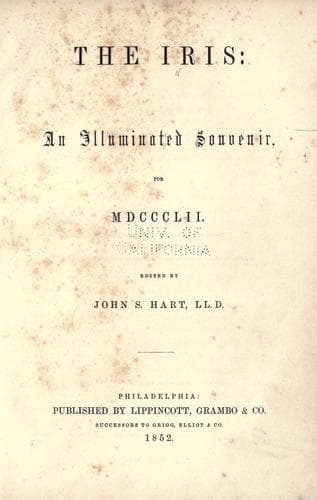
Gift books; Indians of North America -- Literary collections
The battles of their gods are unending themes of adventure among the
Sioux. Conversing upon them, the hours are whiled away from evening
until midnight, and often from midnight to morn. The intellect must
have occupation. How many a noble mind has thus gone to waste!
We may judge, from the importance attached to these fanciful stories,
how hard must be the work of the Indian missionary. What a system of
error to uproot! We may also look into our own hearts:--which is the
greater absurdity, the worship of Chat-o-tee-dah or mammon?--the bowing
down to the glorious works of the hand of God, or devotions paid to the
gilded idol of this world?
Fiery Man no more boasted of his intercourse with the gods; they seemed
to have forgotten they were his friends.
He had sought far and near for his wife. At times his heart was full
of revenge: that she should have destroyed his son was the bitterest
reflection of all. His sister's blood seemed still to be flowing before
him; vengeance was called for on her who had made his lodge dark for
ever. Then a different mood would affect him. She would stand before
him, obedient, docile, and timid, with her soft, fearful voice, so
different from the loud tones of his sister's. He could remember her
so distinctly, as she held up her child for him to see, as he left the
lodge to go with the hunting party. Her long, braided hair, falling
about her shoulders, as her infant's cheek lay pressed against hers.
For the first time he thought she looked sad at parting with him, and
he had treasured the thought. He knew _then_ she never raised her hand
against her child. He would have crushed his evil-minded sister for the
suggestion, had she stood before him in life. He would sit buried in
thought, the storms of passion breaking away from his heart; but this
did not last, and woe to the man who came before him in his fierce mood.
He died in battle; but the Indians said he gave his life away, for he
met his enemy as if he were in a dream, and shouted no cry as he was
wont. They brought his body back and buried it by the side of his son:
and even death did not break the spell of awe connected with him, for
the women were afraid to sit and plait grass near his grave. Harpstinah
moved her lodge from where it stood, saying, she must live farther off
from the graves, that she might not hear Fiery Man in the night calling
for vengeance on his wife, who had deserted him, and murdered his child.
No one could tell the fate of White Moon. Her parents died soon after
her disappearance. But the Black Eagle, who some years after visited
the Sioux who live among the thousand isles at the head of Rum River,
said, that when he arrived there, White Moon's old lover took him to
his lodge, and that his wife helped him off with his snow-shoes, and
made him broth, for he was nearly perished with cold and hunger, having
been at one time covered with snow for several days and nights, as his
only chance of life.
Public-domain text, read in full here on John Shaqi.
Reviews
Reviews
No reviews yet
Be the first to share your thoughts on this work.
Elsewhere in the archive
Join the Discussion
Join the discussion
Sign in to leave a comment or review.
Sign InorCreate an account