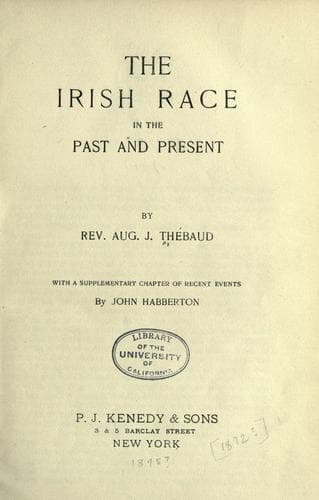
The Irish Race in the Past and the PresentThébaud, Augustus J.
History
The Irish Race in the Past and the Present
Thébaud, Augustus J.
Ireland -- History
The fact is--whatever may be thought or said--the Christian
religion, with all the loveliness it imparts to this world when
rightly understood, though never destroying Nature, but always
keeping it in mind, and consecrating it to God, truly endowed,
consequently, with the promises of earth as well as those of
heaven--the Christian religion is nevertheless fundamentally
supernatural, full of awe and mystery, heavenly and
incomprehensible, before being earthly and the grateful object
of sense.
Without examining the various formularies which heresy compelled
an infallible Church to proclaim and impose upon her children
from time to time, the Apostles' Creed alone transfers man at
once into regions supernatural, into heaven itself. The Trinity,
the Incarnation, the Redemption, the mission of the Hold Ghost
on earth, the communion of saints, the forgiveness of sins, and
the resurrection of the dead, are all mysteries necessitating a
revelation on the part of God himself to make them known to and
believed by man. Do they not place man, even while on earth, in
direct communication with heaven?
The firm believer in those mysteries is already a celestial
citizen by faith and hope. He has acquired a new life, new
senses, as it were, new faculties of mind and will--all things,
evidently, above Nature.
And it is clear, from many passages of the New Testament, that
our Lord wished the lives of his disciples to be wholly
penetrated with that supernatural essence. They were not to be
men of the earth, earthly, but citizens of another country which
is heavenly and eternal. Hence the holiness and perfection
required of them--a holiness, according to Christ, like that of
the celestial Father himself; hence contempt for the things of
this world, so strongly recommended by our Lord; hence the
assurance that men are called to be sons of God, the eternal Son
having become incarnate to acquire for us this glorious
privilege; hence, finally, that frequent recommendation in the
Gospel to rely on God for the things of this life, and to look
above all for spiritual blessings.
That reliance is set forth in such terms, in the Sermon on the
Mount, that, taken literally, man should neglect entirely his
temporal advantages, forget entirely _Nature_, and think only of
_grace_, or rather, expect that the things of Nature would be
given us by our heavenly Father "who knows that we need them."
Nature, consequently, assumes a new aspect in this system. It is
no longer a complexity of temporal goods within reach of the
efforts of man, and which it rests with man alone to procure for
himself. It is, indeed, a worldly treasure, belonging to God, as
all else, and which the hand of God scatters profusely among his
creatures. God will not fail to grant to every one what he needs,
if he have faith. Thus God is always visible in Nature; and
redeemed man, raised far above the beasts of the field, has
other eyes than those of the body, when he looks around him on
this world.
Public-domain text, read in full here on John Shaqi.
Reviews
Reviews
No reviews yet
Be the first to share your thoughts on this work.
Elsewhere in the archive
Join the Discussion
Join the discussion
Sign in to leave a comment or review.
Sign InorCreate an account