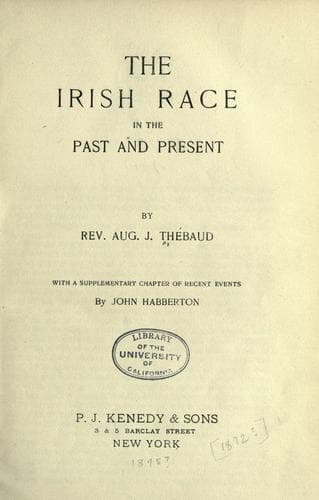
The Irish Race in the Past and the PresentThébaud, Augustus J.
History
The Irish Race in the Past and the Present
Thébaud, Augustus J.
Ireland -- History
Even though one may express doubt as to the reality of this
miracle, one thing, at least, is beyond doubt: that the spirit
of the words of Daria was congenial to the Irish mind at the
time, and that none but one who had first reached the highest
point of supernatural life could conceive or give utterance to
such a sentiment.
That more than human life and spirit elevated, ennobled, and, as
it were, divinized, even the ordinary human and natural feelings,
which not only ceased to become dangerous, but became,
doubtless, highly pleasing to God and meritorious in his sight.
An example may better explain our meaning:
"Ninnid was a young scholar, not over-reverent, whom the
influence of Bridget one day suddenly overcame, so that he
afterward appeared quite a different being. Bridget announced to
him that from his hand she should, for the last time, receive
the body and blood of our Lord. Ninnid resolved that his hand
should remain pure for so high and holy an office. He enclosed
it in an iron case, and wishing at the same time to postpone, as
far as lay in his power, the moment that was to take Bridget
from the world, he set out for Brittany, throwing the key of the
box into the sea. But the designs of God are immutable. When
Bridget's hour had come, Ninnid was driven by a storm on the
Irish coast, and the key was miraculously given up by the deep."
Where, except in Ireland, could such friendship continue for
long years, without giving cause not only for the least scandal,
but even for the remotest danger? In that island the natural
feelings of the human heart were wholly absorbed by heavenly
emotions, in which nothing earthly could be found? Hence the
celebrated division of the "three orders of the Irish saints,"
the first being so far above temptation that no regulation was
imposed on the Cenobites with respect to their intercourse with
women.
"Women were welcome and cared for; they were admitted, so to
speak, to the sanctuary; it was shared with them, occupied in
common. Double, or even mixed monasteries, so near to each other
as to form but one, brought the two sexes together for mutual
edification; men became instructors of women; women of men."
Nothing of the kind was ever witnessed elsewhere; nothing of the
kind was to be seen ever after. Robert of Arbrissel established
something similar in the order, of Fontevrault in France; but
there it was a strange and very uncommon exception; in Ireland
for two centuries it was the rule. This alone would show how
completely the Christian spirit had taken possession of the
whole race from the first.
It is this which gives to Irish hagiology a peculiar character,
making it appear strange even to the best men of other nations.
The elevation of human feeling to such a height of perfection is
so unusual that men cannot fail to be surprised wherever they
may meet it.
Public-domain text, read in full here on John Shaqi.
Reviews
Reviews
No reviews yet
Be the first to share your thoughts on this work.
Elsewhere in the archive
Join the Discussion
Join the discussion
Sign in to leave a comment or review.
Sign InorCreate an account