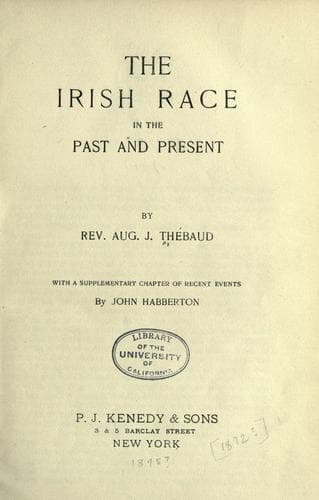
The Irish Race in the Past and the PresentThébaud, Augustus J.
History
The Irish Race in the Past and the Present
Thébaud, Augustus J.
Ireland -- History
Arrived on the coast they had determined to ravage, they soon
found that in stormy weather they were in a more dangerous
position than at sea. Hence they looked for a deep bay, or,
better still, the mouth of a large river, and once on its placid
bosom they felt themselves masters of the whole country. The
terror of the people, the lack of organization for defence, so
characteristic of Celtic or purely Germano-Franco society, the
savage bravery and reckless impetuosity of the invaders
themselves, increased their rashness, and urged them to enter
fearlessly into the very heart of a country which lay prostrate
with fear before them. All the cities on the river-banks were
plundered as they passed, people of whatever age, sex, or
condition, were murdered; the churches especially were despoiled
of their riches, and the numerous and wealthy monasteries then
existing were given to the flames, after the monks and all the
inmates even to the schoolchildren, had been promiscuously
slaughtered, if they had not escaped by flight.
But, although all were slaughtered promiscuously, a special
ferocity was always displayed by the barbarous conqueror toward
the unarmed and defenceless ministers of religion. They took a
particular delight in their case in adding insult to cruelty;
and not without reason did the Church at that time consider as
martyrs the priests and monks who were slain by the pagan
Scandinavians. Their sanguinary and hideous idolatry showed its
hatred of truth and holiness in always manifesting a peculiar
atrocity when coming in contact with the Church of Christ and
her ministers. And, our chief object in speaking of the stand
made by the Irish against the pagan Danes is, to show how the
clan-system became in truth the avenger of God's altars and the
preserver of the sacred edifices and numerous temples with which,
as we have seen, the Island of Saints was so profusely studded,
from total annihilation.
Knowing that, when their march of destruction had taken them a
great distance from the mouth of the river, the inhabitants
might rise in sheer despair and cut them off on their return,
the Scandinavian pirates, to guard against such a contingency,
looked for some island or projecting rock, difficult of access,
which they fortified, and, placing there the plunder which
loaded their boats, they left a portion of their forces to guard
it, while the remainder continued their route of depredation. In
Ireland they found spots admirably adapted for their purpose in
the numerous loughs into which many of the rivers run.
Public-domain text, read in full here on John Shaqi.
Reviews
Reviews
No reviews yet
Be the first to share your thoughts on this work.
Elsewhere in the archive
Join the Discussion
Join the discussion
Sign in to leave a comment or review.
Sign InorCreate an account