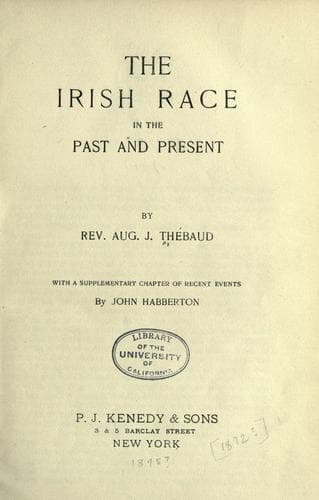
The Irish Race in the Past and the PresentThébaud, Augustus J.
History
The Irish Race in the Past and the Present
Thébaud, Augustus J.
Ireland -- History
Blood-thirsty, stained with every crime,
An artful, cunning, deadly foe,
Lawless, vaunting, rash, inconstant,
True well-spring of unending woe!"
Hastings never yielded to the new religion, which he always
hated and persecuted. But, even after their conversion to
Christianity, his countrymen for a long time retained their
inborn love of bloodshed and tyranny; they were in this respect,
as in many others, the very reverse of the Irish.
Of Rollo, the first Christian Duke of Normandy, Adhemar, a
contemporary writer, says:
"On becoming Christian, he caused many captives to be beheaded
in his presence, in honor of the gods whom he had worshipped.
And he also distributed a vast amount of money to the Christian
churches in honor of the true God in whose name he had received
baptism;" which would seem to imply that this transaction
occurred on the very day of his baptism.
We may now compare the success which attended the arms of these
terrible invaders throughout the rest of Europe with their
complete failure in Ireland. It will be seen that the deep
attachment of the Irish Celts for their religion, its altars,
shrines, and monuments, was the real cause of their final
victory. We shall behold a truly Christian people battling
against paganism in its most revolting and audacious form.
But, first, how stood the case in England?
"It is not a little extraordinary," says a sagacious writer in
the _Dublin Review_ (vol. xxxii., p. 203), "that the three
successive conquests of England by the Anglo-Saxons, Danes, and
Normans, were in fact conquests made by the same people, and, in
the last two instances, over those who were not only descended
from the same stock, but who had immigrated from the very same
localities. The Jutes, Angles, and Saxons, were for the most
part Danes or of Danish origin. Their invasion of England
commenced by plunder and ended by conquest. These were
overthrown by the Danes and Norwegians in precisely the same
manner.
"In the year 875, Roll or Rollo, having been expelled from
Norway by Harold Harfager, adopted the profession of a sea-kong,
and in the short space of sixteen years became Duke of Normandy
and son-in-law of the French king, after having previously
repudiated his wife. The sixth duke in succession from Rollo was
William, illegitimate son of Robert le Diable and Herleva, a
concubine. By the battle of Hastings, which William gained in
1066, over King Harold, who was slain in it, the former became
sovereign of England, and instead of the appellation of 'the
Bastard,' by which he had been hitherto known, he now obtained
the surname of 'the Conqueror.'
"Thus both the Saxon and Danish invaders were subdued by their
Norman brethren."
All the Scandinavian invasions of England were, therefore,
successful, each in turn giving way before a new one; and it is
not a little remarkable that the very year in which Brian Boru
dealt a death-blow to the Danes at Clontarf witnessed the
complete subjection of England by Canute.
Public-domain text, read in full here on John Shaqi.
Reviews
Reviews
No reviews yet
Be the first to share your thoughts on this work.
Elsewhere in the archive
Join the Discussion
Join the discussion
Sign in to leave a comment or review.
Sign InorCreate an account