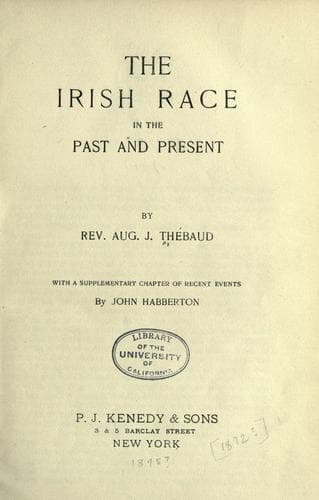
The Irish Race in the Past and the PresentThébaud, Augustus J.
History
The Irish Race in the Past and the Present
Thébaud, Augustus J.
Ireland -- History
It is needless to go into the glorious and romantic history of
the Geraldine family. Elizabeth chose them for the first object
of her attack, because they, as Anglo-Irish Catholics, were more
odious in her eye than the pure Irish.
She knew that the then Earl of Desmond had escaped almost by
miracle from the island with his younger brother John, when the
rest of the noble stock had been butchered at Tyburn. She knew
that Gerald, after many wanderings, had finally reached Rome,
been educated under the care of his kinsman, Cardinal Pole,
cherished as a dear son by the reigning Pontiff, had
subsequently appeared at the Tuscan court of Cosmo de Medici;
that consequently, since his return to Ireland, he might be
considered the chief of the Catholic party there, although, to
save himself from attainder and hold possession of his immense
wealth in Munster, he displayed the greatest reserve in all his
actions, appeared to respect the orders of the queen in all
things, even in her external policy against the Church; so that
if priests were entertained in his castles, it was always by
stealth, and they were compelled to lead a life of total
retirement.
But, despite all this outward show, Elizabeth knew that Gerald
was really a sincere Catholic, that he considered himself a
sovereign prince, and would consequently have small scruple
about entering into a league against her, not only with the
northern Irish chieftains, but even with the Catholic princes of
the Continent. She resolved, therefore, to destroy him.
Sidney was sent to Ireland as lord-lieutenant. He travelled
first through all Munster, and complained bitterly that the
Irish chieftains were destroying the country by their divisions,
though perfectly conscious that those divisions were secretly
encouraged by England. He appeared to listen to the people, when
they complained of their lords, and yet at the holding of
assizes he hanged this same people on the flimsiest pretexts,
and had them executed wholesale. In one of his dispatches to the
home government, he makes complacent allusion to the countless
executions which accompanied his triumphant progress through
Munster: "I wrote not," he says, "the name of each particular
varlet that has died since I arrived, as well by the ordinary
course of the law, and the martial law, as flat fighting with
them, when they would take food without the good-will of the
giver; for I think it is no stuff worthy the loading of my
letters with; but I do assure you, the number of them is great,
and some of the best, and the rest tremble. For the most part
they fight for their dinner, and many of them lose their heads
before they are served with supper. Down they go in every corner,
and down they shall go, God willing."--(Sidney's Dispatches, Br. M.)
Public-domain text, read in full here on John Shaqi.
Reviews
Reviews
No reviews yet
Be the first to share your thoughts on this work.
Elsewhere in the archive
Join the Discussion
Join the discussion
Sign in to leave a comment or review.
Sign InorCreate an account