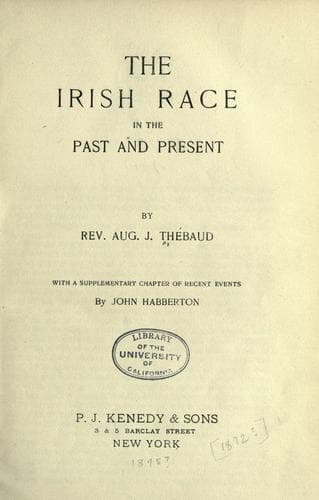
The Irish Race in the Past and the PresentThébaud, Augustus J.
History
The Irish Race in the Past and the Present
Thébaud, Augustus J.
Ireland -- History
But the clannish spirit chiefly showed itself in the authority and
rights of every chieftain in his own territory. He was truly the
patriarch of all under him, acknowledged as he was to be the head
of the family, elected by all to that office at the death of his
predecessor, after due consultation with the files and shanachies,
to whom were intrusted the guardianship of the laws which governed
the clan, and the preservation of the rights of all according to
the strict order of their genealogies and the traditional rules
to be observed.
The power of the chieftain was immense, although limited on every
side by laws and customs. It was based on the deep affection of
relationship which is so ardent in the Celtic nature. For all the
clansmen were related by blood to the head of the tribe, and each
one took a personal pride in the success of his undertakings. No
feudal lord could ever expect from his vassals the like self-devotion;
for, in feudalism, the sense of honor, in clanship, family affection,
was the chief moving power.
In clanship the type was not an army, as in feudalism, but a
family. Such a system, doubtless, gave rise to many inconveniences.
"The breaking up of all general authority," says the Very Rev. Dean
Butler (Introduction to Clyn's "Annals"), "and the multiplication
of petty independent principalities, was an abuse _incident_ on
feudalism; it was _inherent_ in the very essence of the patriarchal
or family system. It began, as feudalism ended, with small independent
societies, each with its own separate centre of attraction, each
clustering round the lord or the chief, and each rather repelling
than attracting all similar societies. Yet it was not without its
advantages. If feudalism gave more strength to attack an enemy,
clanship secured more happiness at home. The first implied only
equality for the few, serfdom or even slavery for the many; the
other gave a feeling of equality to all."
It was, no doubt, this feeling of equality, joined to that of
relationship, which not only secured more happiness for the Celt,
but which so closely bound the nobility of the land to the inferior
classes, and gave these latter so ardent an affection for their
chieftains. Clanship, therefore, imparted a peculiar character
to the whole race, and its effect was so lasting and seemingly
ineradicable as to be seen in the nation to-day.
Wherever feudalism previously prevailed, we remark at this time
a fearful hatred existing between the two classes of the same
nation; and the great majority of modern revolutions had their
origin in that terrible antagonism. The same never existed, and
could not exist, in Celtic Countries; and if England, after a
conflict of many centuries, had not finally succeeded in destroying
or exiling the entire nobility of Ireland, we should, doubtless,
see to this very day that tender attachment between high and low,
rich and poor, which existed in the island in former ages.
Public-domain text, read in full here on John Shaqi.
Reviews
Reviews
No reviews yet
Be the first to share your thoughts on this work.
Join the Discussion
Join the discussion
Sign in to leave a comment or review.
Sign InorCreate an account