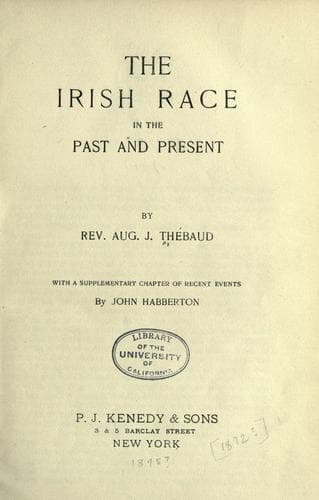
The Irish Race in the Past and the PresentThébaud, Augustus J.
History
The Irish Race in the Past and the Present
Thébaud, Augustus J.
Ireland -- History
But an idolatrous nation could not receive that boon; and the
Roman sway affected very slightly the African and Asiatic nations,
whatever its pretensions may have been.
For, when Rome had subdued what she called Europe, Asia, and Africa
--the whole globe--whenever she found that her empire did not reach
the sea, she established there posts of armed men; colonies were
sent out and legions distributed along the line; even in some places,
as in Britain, walls were constructed, stretching across islands, if
not along continents. Whatever country had the happiness of being
included between those limits belonged to "the city and the world"
-_urbi et orbi_; beyond was Cimmerian darkness in the North, or
burning deserts in the South. Mankind had no right to exist outside
of her sway; and, if some roaming barbarians strayed over the
inhospitable confines, they could not complain at having their
existence swept off from the field of history, so unworthy were
they of the name of men. Science itself, the science of those
times, had to admit such ideas and dictate them to polished writers.
Hence, according to the greatest geographers, mankind could exist
neither in tropical nor in arctic regions; and Strabo, dividing the
globe into five zones, declared that only two of them were habitable.
We now know how false were those assertions, and indeed how
circumscribed was the power of ancient Rome. She pretended to
universal as well as to eternal dominion; but she deceived herself
in both cases. Under her sway the races of Japhet were not "to
dwell in the tents of Sem." She was not worthy of accomplishing
the great prophecy which is now under our consideration.
It is, however, undoubtedly due to her that the children of Japhet
became the dominant race of the globe, and the Eastern nations,
once so active and so powerful, were overshadowed by her glory,
and had already fallen into that slumber which seems eternal.
Egypt was reduced so low that a victorious Roman general had only
to appear on her borders to insure immediate submission.
Syria and Mesopotamia were fast becoming the frightful deserts they
are to-day. Persia dared not move in the awful presence of a few
legions scattered along the Tigris; and, if, later on, the Parthian
kings made a successful resistance against Rome, it was only owing
to the abominable corruption of Roman society at the time; but,
in fact, Iran had fallen to rise no more, save spasmodically
under Mohammedan rule.
Public-domain text, read in full here on John Shaqi.
Reviews
Reviews
No reviews yet
Be the first to share your thoughts on this work.
Elsewhere in the archive
Join the Discussion
Join the discussion
Sign in to leave a comment or review.
Sign InorCreate an account