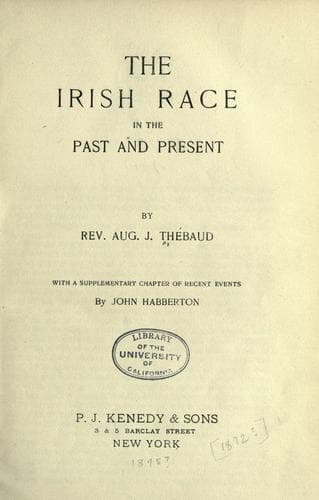
The Irish Race in the Past and the PresentThébaud, Augustus J.
History
The Irish Race in the Past and the Present
Thébaud, Augustus J.
Ireland -- History
The fact is, that, in the subsequent flood of barbarians which for
centuries overwhelmed and destroyed the whole of Europe, we behold,
on all sides, streams of Northern European races, members of the
same family of Japhet. It was the Goths that ruined Palestine even
in the time of St. Jerome. If side by side with Northern nations
the Huns appeared, no one knows precisely whence they came. Attila
called himself King of the Scythians and the Goths, as well as
grandson of Nimrod. He came with his mighty hosts from beyond the
Danube; this is all that can be said with certainty of his origin.
The East, therefore, was already dead, and could furnish no powerful
foe against that Rome which it detested. It is even in this Oriental
supineness that we can find a reason for the duration of the
inglorious empire of Constantinople. Rome and the West, though far
more vigorous, were overwhelmed by barbarians of the same original
stock sent by Providence to "renew its youth like that of the eagle."
Constantinople and the East continued for a thousand years longer to
drag out their feeble existence, because the far Orient could not
send a few of its tribes to touch their walls and cause them to
crumble into dust. It is even remarkable that the armies of Mohammed
and his successors, in the flush of their new fanaticism, did not
dare for a long time to attack the race of Japhet settled on the
Bosporus. From their native Arabia they easily overran Egypt and
Northern Africa, Syria and Palestine, Mesopotamia and Persia. But
Asia Minor and Thrace remained for centuries proof against their
fury, and, whenever their fleets appeared in the Bosporus, they
were easily defeated by the unworthy successors of Constantine
and Theodosius. This fact, which has not been sufficiently noticed,
shows conclusively that the energy imparted by Mohammedanism
to Oriental nations would have lasted but a short time, and
encountered in the West a successful resistance, had not the
Turks appeared on the scene, destroyed the Saracen dynasties,
and, by infusing the blood of Central Asia into the veins of
Eastern and Southern fanatics, prolonged for so many ages the
sway of the Crescent over a large portion of the globe.
This was the turning-point in human affairs between the East and
the West. We do not write history, and cannot, consequently, enter
into details. It is enough to say that a new element, strengthened
by a long struggle with Moslemism, was to give to the West a lasting
preponderance which ancient Rome could not possess, and whose
developments we see in our days. This new element was the Christian
religion, solidly established on the ruins of idolatry and heresy;
far more solidly established, consequently, than under the Christian
emperors of Rome, while paganism still existed in the capital itself.
Public-domain text, read in full here on John Shaqi.
Reviews
Reviews
No reviews yet
Be the first to share your thoughts on this work.
Elsewhere in the archive
Join the Discussion
Join the discussion
Sign in to leave a comment or review.
Sign InorCreate an account