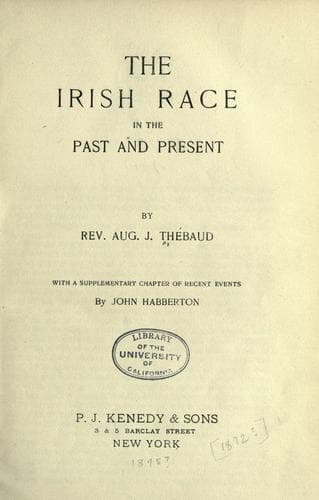
The Irish Race in the Past and the PresentThébaud, Augustus J.
History
The Irish Race in the Past and the Present
Thébaud, Augustus J.
Ireland -- History
Finally, in Australia and the Pacific Ocean the disappearance of
the natives is still more striking and more sudden in its action
than even in America.
This state of things did not exist two hundred years ago; and
when the Crusades began the reverse was the case.
We cannot believe that this immense, universal fact is merely an
exterior one resulting from new appliances, new comforts, new
outward habits; what is called material civilization. We cannot
believe that it is merely the dress, houses, culinary regime, the
popular customs of those numerous foreign tribes or nations which
are undergoing such a wonderful change. This outward phenomenon
supposes a _substratum_, an interior reality of ideas and principles
worthy our chief attention as the real cause of all those exterior
changes; a cause, nevertheless, which is scarcely thought of in
the public estimate of this mighty revolution.
It is the mind of Europe: it is the belief or want of belief,
the religious or irreligious views, the grasping ambition, the
headlong desire of an impossible or unholy happiness, the reckless
sway of unbridled passions, which try to spread themselves among
all nations, and bring them all up, or rather down, to the level
of intoxicated, tottering, maddened Europe.
If the monstrous scheme succeeds, there will be no more prayer in
the villages of the devout Maronites, no more submission to God in
the mountains of Armenia, no more simplicity of faith among the
shepherds of Chaldea, no more purity of life among the wandering
children of Asiatic deserts.
Side by side with truth and virtue many errors and monstrosities
will doubtless disappear, but not to be replaced with what is
much better.
The muezzin of the mosques will no longer raise his voice from the
minarets at noon and nightfall; the simple Lama will no longer
believe in the successive incarnations of Buddha; no longer will
the superstitious Hindoo cast himself beneath the car of Juggernaut;
many another such absurdity and crime will, let us hope, disappear
forever. But with what benefit to mankind? After all, is not
superstition even better for men than total unbelief? And, when
the whole world is reduced to the state of Europe, when what we
daily witness there shall be reproduced in all continents and
islands, will men really be more virtuous and happy?
We must not think, however, that there is nothing truly good in
the stupendous transformation which we have endeavored to sketch.
If it really be the accomplishment of the great prophecy mentioned
by us at the beginning of this chapter, it is a noble and a
glorious event. God will know how to turn it to good account, and
it is for us to hail its coming with thankfulness.
Public-domain text, read in full here on John Shaqi.
Reviews
Reviews
No reviews yet
Be the first to share your thoughts on this work.
Elsewhere in the archive
Join the Discussion
Join the discussion
Sign in to leave a comment or review.
Sign InorCreate an account