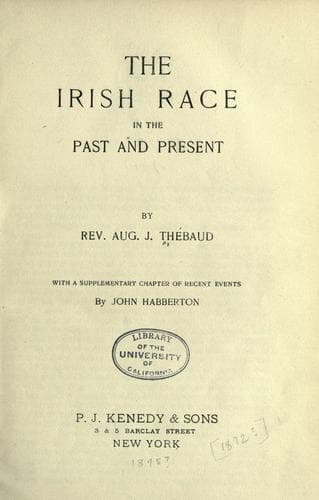
The Irish Race in the Past and the PresentThébaud, Augustus J.
History
The Irish Race in the Past and the Present
Thébaud, Augustus J.
Ireland -- History
"Englishmen have made a careful survey of the whole of the
Mediterranean Sea, of the course of the Indus, the Ganges, the
Bramaputra, the Godavery, and other rivers of India; of the
whole littoral between Cape Colony and China; England has steamships
on the Amazon and Niger, and her vessels are found everywhere on
the coast of Chili and Peru."
Other European families try to follow in her footsteps; at their
head the United States now stand. Primitively an offshoot of the
English stock, the blood of all other Japhetic races has given the
latter country an activity and boldness which will render it in
time superior in those respects to the mother-country herself.
Yet at this time, even in the presence of the United States, in
the presence of all other maritime powers, England stands at the
head of the Japhetic movement.
Unfortunately, her first aim, after acquiring wealth and securing
her power, is, to exclude the Roman Catholic Church as far as is
practicable from the benefit of the system, to oppose her whenever
she would follow in the wake of her progress, and either to allow
paganism or Mohammedanism to continue in quiet possession wherever
they exist, or to substitute for them as far as possible her
Protestantism. At all events, the Catholicity of the Church is
to be crushed, or at least thwarted, to make room for the
catholicity of the English nation.
And it looks as though such, in truth, would have been the result,
had not the stubbornness of the Irish character stood in the way;
if the Celt of Erin, after centuries of oppression and opposition
to the false wanderings of the European stream, had not insisted
on following the English lord in his travels, dogging his steps
everywhere, entering his ships welcome or unwelcome, rushing on
shore with him wherever he thought fit to land, and there planted
his shanty and his frame church in the very sight of stately
palaces lately erected, and gorgeous temples with storied windows
and softly-carpeted floors.
And after a few years the Irish Celt would show himself as active
and industrious in his new country as oppression had made him
indolent and careless on his own soil; the shanty would be replaced
by a house worthy of a man; above all, the humble dwelling which he
first raised to his God would disappear to make room for an edifice
not altogether unworthy of divine majesty; at least, far above the
pretentious structures of the oppressors of his religion. The eyes
of men would be again turned to "the city built upon a mountain;" and
the character of universality, instead of being wrested from the true
Church, would become more resplendent than ever through the steadfast
Irish Celt.
Thus the spreading of the Gospel in distant regions would be
accomplished without a navy of their own. As their ancestors did
in pagan times, they would use the vessels of nations born for
thrift and trade; the stately ships of the "Egyptians" would be
used by the true "people of God."
Public-domain text, read in full here on John Shaqi.
Reviews
Reviews
No reviews yet
Be the first to share your thoughts on this work.
Elsewhere in the archive
Join the Discussion
Join the discussion
Sign in to leave a comment or review.
Sign InorCreate an account