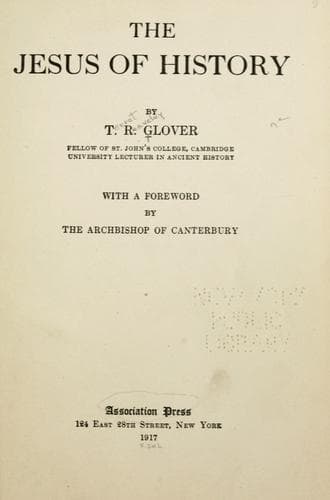
The Jesus of HistoryGlover, T. R. (Terrot Reaveley)
Religion
The Jesus of History
Glover, T. R. (Terrot Reaveley)
Jesus Christ -- Historicity
Gautama Buddha, for instance, and the greater Hindu thinkers, in
their doctrine of Karma, have taught a significance inherent in good
and evil, which we can only not call boundless. Buddha did this
without any great consciousness of God; and many Indian thinkers
have so emphasized the doctrine that it has taken all the stress
laid on "Bhakti" by Ramanuja and others to restore to life a
perspective or a balance, however it should be described, that will
save men from utter despair. Nor is it Eastern thinkers only who
have taught men the reality of heaven and hell. The poetry of
Aeschylus is full of his great realization of the nexus between act
and outcome. With all the humour and charm there is in Plato, we
cannot escape his tremendous teaching on the age-long consequences
of good and evil in a cosmos ordered by God. Carlyle, in our own
days, realized the same thing--he learnt it no doubt from his
mother; and learnt it again in London. In Mrs. Austen's
drawing-room, with "Sidney Smith guffawing," and "other people
prating, jargoning, to me through these thin cobwebs Death and
Eternity sate glaring." "How will this look in the Universe," he
asks, "and before the Creator of Man?" When someone in his old age
challenged him with the question, "Who will be judge?"--(it is
curious how every sapient inanity strikes, as on an original idea,
on the notion that opinions differ, and therefore--apparently, if
their thought has any consequence--are as good one as another)--Who
will be judge? "Hell fire will be judge," said Carlyle, "God
Almighty will be the judge now and always." There is a gulf between
good and evil, and each is inexorably fertile of consequence. There
is no escaping the issue of moral choice. That is the conclusion of
men who have handled human experience in a serious spirit. As
physical laws are deducible from the reactions of matter and force,
and are found to be uniform and inevitable, fundamental in the
nature of matter and force, so clear-thinking men in the course of
ages have deduced moral laws from their observation of human nature,
laws as uniform, inevitable and fundamental. In neither case has it
been that men invented or imagined the laws; in both cases it has
been genuine discovery of what was already existent and operative,
and often the discovery has involved surprise.
If Jesus had failed to see laws so fundamental, which other teachers
of mankind have recognized, it is hardly likely that his teaching
would have survived or influenced men as it has done. Mankind can
dispense with a teacher who misses patent facts, whatever his charm.
But there never was any doubt that Jesus was alive to the difference
between right and wrong. His critics saw this, but they held that he
confused moral issues, and that his distinctions in the ethical
sphere were badly drawn.
Public-domain text, read in full here on John Shaqi.
Reviews
Reviews
No reviews yet
Be the first to share your thoughts on this work.
Elsewhere in the archive
Join the Discussion
Join the discussion
Sign in to leave a comment or review.
Sign InorCreate an account