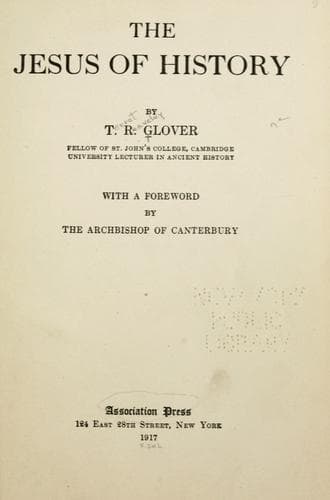
The Jesus of HistoryGlover, T. R. (Terrot Reaveley)
Religion
The Jesus of History
Glover, T. R. (Terrot Reaveley)
Jesus Christ -- Historicity
For
the mind is dyed (or stained) by its thoughts." "Phantazesthai" and
"phantasiai" are the words--and they suggest something between
thoughts and imaginations--mental pictures would be very near it.
The third group whom Jesus warned, the most notorious of all, was
the Pharisee class. They played at religion--tithed mint and anise
and cumin, and forgot judgement and mercy and faith (Matt. 23:23).
Jesus said that the Pharisee was never quite sure whether the
creature he was looking at was a camel or a mosquito--he got them
mixed (Matt. 23:24). Once we realize what this tremendous irony
means, we are better able to grasp his thought. The Pharisee was
living in a world that was not the real one--it was a highly
artificial one, picturesque and charming no doubt, but dangerous.
For, after all, we do live in the real world--there is only one
world, however many we may invent; and to live in any other is
danger. Blindness, that is partial and uneven, lands a man in peril
whenever he tries to come downstairs or to cross the street--he
steps on the doorstep that is not there and misses the real one. He
is involved in false appearances at every turn. And so it is in the
moral world--there is one real, however many unreals there are, and
to trust to the unreal is to come to grief on the real. "The
beginning of a man's doom," wrote Carlyle, "is that vision be
withdrawn from him." "Thou blind Pharisee!" (Matt. 23:26). The cup
is clean enough without; it is septic and poisonous within--and from
which side of it do you drink, outside or inside? (Matt. 23:25). As
we study the teaching of Jesus here, we see anew the profundity of
the saying attributed to him in the Fourth Gospel, "The truth shall
make you free" (John 8:32). The man with astigmatism, or myopia, or
whatever else it is, must get the glasses that will show him the
real world, and he is safe, and free to go and come as he pleases.
See the real in the moral sphere, and the first great peril is gone.
Nothing need be said at this point of the Pharisee who used
righteousness and long prayers as a screen for villainy. Probably
his doom was that in the end he came to think his righteousness and
his prayers real, and to reckon them as credit with a God, who did
not see through them any more than he did himself. It is a mistake
to over-emphasize here the devouring of widow' houses by the
Pharisee (Matt. 23:14), for it was no peculiar weakness of his;
publicans and unjust judges did the same. Only the publican and the
unjust judge told themselves no lies about it. The Pharisee
lied--lying to oneself or lying to another, which is the worse? The
more dangerous probably is lying to oneself, though the two
practices generally will go together in the long run. The worst
forms of lying, then, are lying to oneself and lying about God; and
the Pharisee combined them, and told himself that, once God's proper
dues of prayer and tithe were paid, his treatment of the widow and
her house was correct.
Public-domain text, read in full here on John Shaqi.
Reviews
Reviews
No reviews yet
Be the first to share your thoughts on this work.
Elsewhere in the archive
Join the Discussion
Join the discussion
Sign in to leave a comment or review.
Sign InorCreate an account