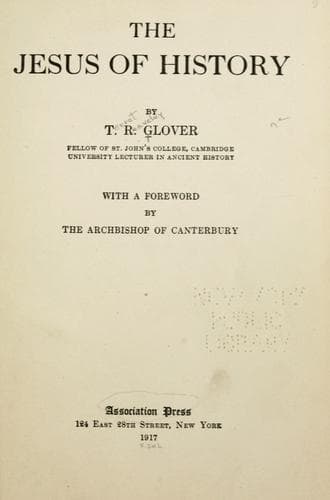
The Jesus of HistoryGlover, T. R. (Terrot Reaveley)
Religion
The Jesus of History
Glover, T. R. (Terrot Reaveley)
Jesus Christ -- Historicity
The Christians out-thought the pagan world. How could they fail to?
"We have peace with God," said Paul. They moved about in a new
world, which was their Father's world. They would go to the shrines
and ask uncomfortable questions. Lucian, who was a pagan and a
scoffer, said that on one side of the shrines the notice was posted:
"Christians outside." The Christians saw too much. The living god in
that shrine was a big snake with a mask tied on--good enough for the
pagan; but the Christian would see the strings. Even the daemons
they dismissed to irrelevance and non-entity. The essence of magic
was to be able to link the name of a daemon with the name of one's
enemy, to set the daemon on the man. "Very well," said the
Christian, "link my name with your daemons. Use my name in any magic
you like. There is a name that is above every name; I am not
afraid." That put the daemons into their right place, and by and by
they vanished, dropped out, died of sheer inanition and neglect.
Wherever Jesus Christ has been, the daemons have gone. "There used
to be fairies," said an old woman in the Highlands of Scotland to a
friend of mine, "but the Gospel came and drove them away." I do not
know what is going to keep them away yet but Jesus Christ. The
Christian read the ancient literature with the same freedom of mind,
and was not in bondage to it; he had a new outlook; he could
criticize more freely. One great principle is given by Clement of
Alexandria: "The beautiful, wherever it is, is ours, because it came
from our God." The Christian read the best books, assimilated them,
and lived the freest intellectual life that the world had. Jesus had
set him to be true to fact. Why had Christian churches to be so much
larger than pagan temples? Why are they so still? Because the sermon
is in the very centre of all Christian worship--clear, definite
Christian teaching about Jesus Christ. There is no place for an
ignorant Christian. From the very start every Christian had to know
and to understand, and he had to read the Gospels; he had to be able
to give the reason for his faith. He was committed to a great
propaganda, to the preaching of Jesus, and he had to preach with
penetration and appeal. There they were loyal to the essential idea
of Jesus--they were "sons of fact." They read about Jesus,[32] and
they knew him, and they knew where they stood. This has been the
essence of the Christian religion. Put that alongside of the pitiful
defence which Plutarch makes of obscene rites, filthy images,
foolish traditions. Who did the thinking in that ancient world?
Again and again it was the Christian. He out-thought the world.
Public-domain text, read in full here on John Shaqi.
Reviews
Reviews
No reviews yet
Be the first to share your thoughts on this work.
Elsewhere in the archive
Join the Discussion
Join the discussion
Sign in to leave a comment or review.
Sign InorCreate an account