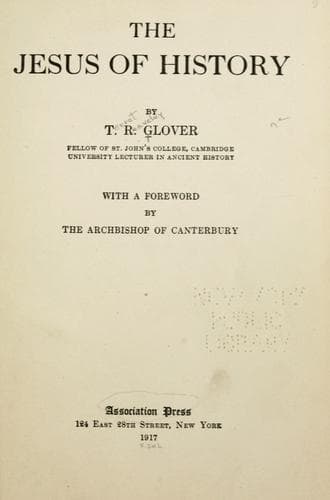
The Jesus of HistoryGlover, T. R. (Terrot Reaveley)
Religion
The Jesus of History
Glover, T. R. (Terrot Reaveley)
Jesus Christ -- Historicity
Plato, in the sentence already quoted, tells us that "the unexamined
life is unliveable for a human being, for a real man." Here, then,
came into man's life a new experience altogether, like nothing known
before altering everything, giving new sympathies, new passions, new
enthusiasms--a new attitude to God and a new attitude to men. It was
inevitable that thought must work upon it. Who was this Jesus that
he should produce this result? Men asked themselves that very early;
and if they were slow to do so, the criticism of the outsider drove
them into it. The result has been nineteen centuries of endless
question and speculation as to Jesus Christ--the rise of dogma,
creed, and formula, as slowly all the philosophy of mankind has been
re-thought in the light of the central experience of Jesus Christ.
In spite of all that we may regret in the war of creeds, it was
inevitable--it was part of the disturbance that Jesus foresaw he
must make (Luke 12:51). Men "could do no other"--they had to
determine for themselves the significance of Jesus in the real
world, in the whole cosmos of God; and it meant fruitful conflict of
opinion, the growth of the human mind, and an ever-heightened
emphasis on Jesus.
An analogy may illustrate in some way the story before us. One of
the most fascinating chapters of geography is the early exploration
of America. Chesapeake Bay was missed by one explorer. Fog or
darkness may have been the cause of his missing the place; but he
missed it, and, though it is undoubtedly there, he made his map
without it. Now let us suppose a similar case--for it must often
have happened in early days--and this time we will say it was the
Hudson, or some river of that magnitude. A later explorer came, and
where the map showed a shore without a break, he found a huge inlet
or outlet. Was it an arm of the sea, a vast bay, or was it a great
river? A very great deal depended on which it was, and the first
thing was to determine that. There were several ways of doing it.
One was to sail up and map the course. A quicker way was to drop a
bucket over the side of the ship. The bucket, we may be sure, went
down; and it came up with fresh water; and the water was an instant
revelation of several new and important facts. They had discovered,
first of all, that where there was an unbroken coast-line on the
map, there was nothing of the kind in reality; there was a broad
waterway up into the country; and this was not a bay, but the mouth
of a river, and a very great river indeed; and this implied yet
another discovery--that men had to reckon with no mere island or
narrow peninsula, but an immense continent, which it remained to
explore.
Public-domain text, read in full here on John Shaqi.
Reviews
Reviews
No reviews yet
Be the first to share your thoughts on this work.
Elsewhere in the archive
Join the Discussion
Join the discussion
Sign in to leave a comment or review.
Sign InorCreate an account