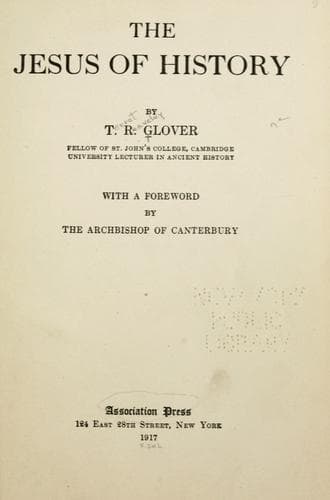
The Jesus of HistoryGlover, T. R. (Terrot Reaveley)
Religion
The Jesus of History
Glover, T. R. (Terrot Reaveley)
Jesus Christ -- Historicity
In dealing with all these three groups of records, we have to note
the seriousness of the men who made the experiments, their energy of
mind, their determination to reach real facts and, in Cromwell's
great phrase, to "speak things." They will have the truth of the
matter. Intricate and entangled as is the history, for instance, of
the Arian controversy--that controversy which "turned on a
diphthong," as Carlyle said in his younger days--it represented far
more than mere logomachy, as Carlyle saw later on. It followed from
a determination to get at the real fact of who and what Jesus Christ
is; and the two words, that differed by a diphthong, embodied
diametrically opposite conceptions of him. With all the
super-subtlety that sometimes characterizes theologians, these men
had a passion for truth. It led them into paths where our minds find
a difficulty in following; but the motive was the imperative sense
that thinking men must examine and understand their supreme
experience--a motive that must weigh with men who are in earnest
about life. The great hymns of the Church--such as the "Dies Irae"
of Thomas of Celano, or Bernard's "Jesu dulcis memoria", or
Toplady's "Rock of Ages"--are transcripts from life, made by
deep-going and serious minds. The writers are recording, with deep
conviction of its worth, what they have discovered in experience. A
man who takes Christ seriously and will "examine life," will often
find in those great hymns, it may be with some surprise, an
anticipation of his own experience as Bunyan did in Luther's
Commentary on Galatians. Livingstone had "Jesu dulcis memoria"--the
Latin of it--ringing in his head as he travelled in unexplored
Africa. Men who did such work--work that lasts and is recognized
again and again to be genuine by others busy in the same
field--cannot have been random, light-hearted creatures. They were,
in fact, men tested in life, men of experience of wide and deep
experience--men with a gift for living, developed in heart as well
as in brain. The finest of Greek critics, Longinus, said that, "The
great style ("hupsos") is an echo of a great soul." Neander
said--and it is again and again true--that "it is the heart that
makes the theologian." Where we find a great hymn or a great
theology, we may be sure of finding a great nature and a great
experience behind it.
Public-domain text, read in full here on John Shaqi.
Reviews
Reviews
No reviews yet
Be the first to share your thoughts on this work.
Elsewhere in the archive
Join the Discussion
Join the discussion
Sign in to leave a comment or review.
Sign InorCreate an account