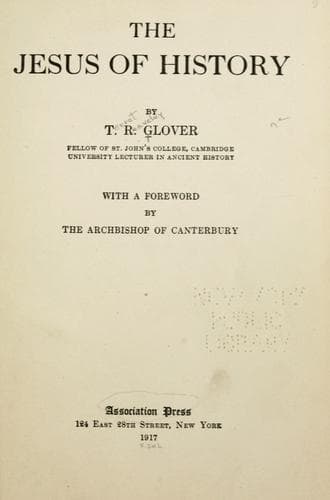
The Jesus of HistoryGlover, T. R. (Terrot Reaveley)
Religion
The Jesus of History
Glover, T. R. (Terrot Reaveley)
Jesus Christ -- Historicity
The historical character of Christian life and thought is surely
evidence that Jesus Christ has accomplished something real; and when
we get a better hold of that, the problem of his person should be
more within our reach. The splendid phrase of Paul--"Therefore being
justified by faith, we have peace with God through our Lord Jesus
Christ" (Rom. 5:1)--or that of 1 Peter: "In whom ye rejoice ... with
joy unspeakable and full of glory" (1 Pet. 1:8)--gives us the
keynote. The gaiety of the Early Church in its union with Jesus
Christ rings through the New Testament and the Christian fathers
from Hermas to Augustine. The Church has come singing down the
ages.[36] The victory over sin--no easy thing at any time--is
another permanent feature of Christian experience. The psychological
value of what Dr. Chalmers called "the expulsive power of a new
affection" is not enough studied by us. Look at the freedom, the
growth, the power of the Christian life--where do they all come
from? We cannot leave God out of this. At any rate, there they are
in the Christian experience; and where does anything that matters
flow from but from God? There is again the evidence of Christian
achievement; and it should be remarked that the Christian always
tells us that he himself has not the power, that it comes from God,
that he asks for it and God gives it. As for the easy explanation of
all religious life by "auto-suggestion," we may note that it
involves a loose and unscientific use of a more or less scientific
theory--never a very safe way to knowledge. In any case, it has been
pointed out, the word adds nothing to the number of our facts; nor
is it quite clear yet that it eliminates God from the story any more
than the term "digestion" makes it inappropriate to say Grace before
meat. All these things--peace, joy, victory, and the rest--follow
from the taking away of sin, and imply that it no longer stands
between God and man. All this is the work of the historical Jesus.
It is he who has changed the attitude of man to God, and by changing
it has made it possible for God to do what he has done. If God, in
Paul's phrase, "hath shined in our hearts" (2 Cor. 4:6), it was
Jesus who induced men to take down the shutters and to open the
windows. It is all associated, historically, with the ever-living
Jesus Christ, and with God in him.
This brings us to the central question, the relation of Jesus with
God--the problem of Incarnation. After all that has been said, we
shall not approach it "a priori". We are too apt to put the
Incarnation more or less in algebraic form:
x+y=a,
Public-domain text, read in full here on John Shaqi.
Reviews
Reviews
No reviews yet
Be the first to share your thoughts on this work.
Elsewhere in the archive
Join the Discussion
Join the discussion
Sign in to leave a comment or review.
Sign InorCreate an account