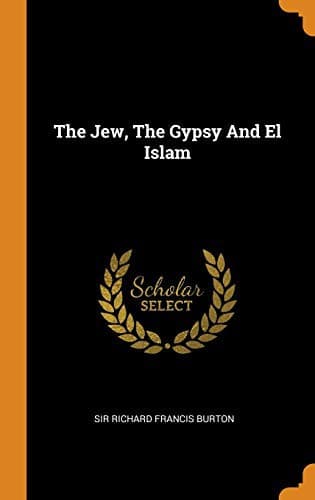
The Jew, The Gypsy and El IslamBurton, Richard Francis, Sir
Islamic
The Jew, The Gypsy and El Islam
Burton, Richard Francis, Sir
Islam; Jews; Romanies
By almost imperceptible degrees the notes and commentaries upon this
text grew to formidable proportions, and became a special science,
whose technical name, found in the Book of Chronicles (2 xiii. 22 and
xxiv. 27), is Midrash, from darash; in Arabic, dars, a lesson. Of the
innumerable methods of studying these Holy Writs, the three principal
are embodied in the Persian Paradís, the Arabic Firdaus, and the
Greek [Greek: Παραδεισος: Paradeisos], written Semitically without
vowels PRDS, and the mysterious letters were assumed mneumonically as
the initial of a technical word. Thus P (Peshat, the simple rendering
of words) recorded the elementary law of Talmudic exegesis, “No verse
of Scripture practically admits any sense but the literal sense,”[62]
although in a different or familiar signification it may be explained
in a host of ways. R (Remiz, the Arabic Ramz, a secret, intimation,
insinuation, or suggestion of meaning) illustrates certain letters
and signs apparently superfluous and explained only by tradition;
in a more general manner, it gave rise to a _memoria technica_ and
a stenography resembling the Roman _Notaricon_. Points and notes
were added to the margins of manuscripts, and thus was founded the
Massorah (tradition), or diplomatic conservation of the text, intended
to preserve its purity. D (Derush, illustration) was the familiar
application of historical, traditional, anecdotical, allegorical, and
prophetical sayings to the actual state of events; it was a sermon
aided by ethics, logic, poetry, parable, proverb, apologue, and the
vast mass of legendary lore known as the Hagadah (plural Hagadoth), as
opposed to the Halakah,[63] or dogmatic part--perhaps it was suggested
by the New Testament. Finally, the fourth and last, S (Sod, secret,
mystery), included the mystical and esoterical sciences of theosophy,
metaphysics, angelology, and a host of supernatural visions, brilliant
and fantastic. It borrowed with impartial hand from the magic of Egypt,
the myths of Hermes Trismegistos, the works of the Platonists and
Neo-Platonists, and the labours of the Christian Gnostics. Few were
initiated into “the Creation,” or “the Chariot,” as it was called,
alluding to the vision of Ezekiel; yet its attractions were such that
at last “Paradise” was confined to this special branch of esoteric
science, even as later in Gnosticism it came to signify the Spiritual
Christ.
Public-domain text, read in full here on John Shaqi.
Reviews
Reviews
No reviews yet
Be the first to share your thoughts on this work.
Elsewhere in the archive
Join the Discussion
Join the discussion
Sign in to leave a comment or review.
Sign InorCreate an account