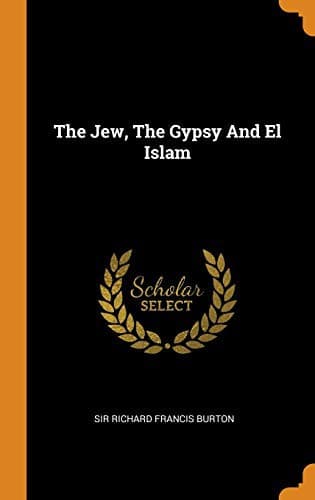
The Jew, The Gypsy and El IslamBurton, Richard Francis, Sir
Islamic
The Jew, The Gypsy and El Islam
Burton, Richard Francis, Sir
Islam; Jews; Romanies
R. Jacob Be-Rab, in the second part of his Joré Déah (Yurah daah),
asserts that it is unlawful to draw a Gentile out of a well into which
he may have descended or fallen. He also declares that the scrupulous
Jewish physician who thoroughly conforms to Talmudic Law will not
attend a Gentile without honorarium, because this will be his sole
reward. He may do so gratuitously, if he wishes to study medicine by
that means; but he should usually kill such patients whilst pretending
to cure them. This, however, must be attempted only when there is no
chance of detection. R. Joseph Caro of Safed, one of the most pestilent
of that School, in his commentary upon the Way of Knowledge, enables
the doctor to do additional harm by calling Gentile fees Kashmad, that
is to say, the wages of sin--a term applied to the price of a woman’s
honour; and in speaking especially of Christians, he declares that if
the Jewish physician takes his fee without poisoning them it is as
the gift to the wicked woman. On the other hand, should the mediciner
be unwilling to be paid, he must absolutely poison his patient. He
also forbids the doctor who has not thoroughly studied the healing art
to attend one of his own faith, lest his ignorance cause death;[77]
but he may practise amongst all others, because if he kill them it is
lawful and no matter (commentary of Gittin, the sixth tract of the
third order). Others declare that the Hebrew physician must not treat
a stranger even for fees; but if he fear the Gentile, and the latter
know him to be a Jew, he may do so for money. Rubbi argues the question
by reference to the Gittin, in which it is related that R. Richmi bin
Askhi had prepared a dose for a stranger; he explains that the drug may
have been given by way of experiment, or for the purpose of study.
The Safed School continued its labours into the seventeenth century,
and Quasimus (writing about A.D. 1625) speaks of it [Safed] as
inhabited chiefly by Hebrews, who had their synagogues and schools, and
for whose sustenance contributions were made by the Jews in other parts
of the world. After that it gradually sank under the oppression of the
Muhammadans, who probably took the place by degrees.
FOOTNOTES:
[34] Mount Moriah (of appearance), afterwards the site of Solomon’s
Temple. Certain modern writers, especially Mr. Mills (_Nablous and the
Samaritans_), would identify Mount Gerizím of Shechem with Moriah; but
the most superficial consideration of the distance to be marched and
the time required proves the theory to be absurd.
Public-domain text, read in full here on John Shaqi.
Reviews
Reviews
No reviews yet
Be the first to share your thoughts on this work.
Elsewhere in the archive
Join the Discussion
Join the discussion
Sign in to leave a comment or review.
Sign InorCreate an account