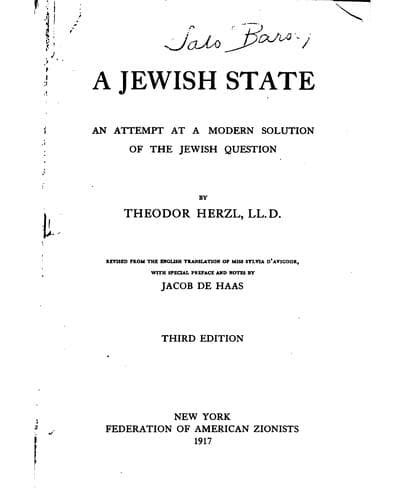
Herzl, Theodor, 1860-1904; Zionism; Zionists -- Austria -- Biography
At the same time the Company will sell estates, or, rather, exchange
them. For a house it will offer a house in the new country; and for
land, land in the new country; everything being, if possible,
transferred to the new soil in the same state as it was in the old.
And this transfer will be a great and recognized source of profit to
the Company. "Over there" the houses offered in exchange will be
newer, more beautiful, and more comfortably fitted, and the landed
estates of greater value than those abandoned; but they will cost the
Company comparatively little, because it will have bought the ground
very cheaply.
PURCHASE OF LAND
The land which the Society of Jews will have secured by international
law must, of course, be privately acquired.
Provisions made by individuals for their own settlement do not come
within the province of this general account. But the Company will
require large areas for its own needs and ours, and these it must
secure by centralized purchase. It will negotiate principally for the
acquisition of fiscal domains, with the great object of taking
possession of this land "over there" without paying a price too high,
in the same way as it sells here without accepting one too low. A
forcing of prices is not to be considered, because the value of the
land will be created by the Company through its organizing the
settlement in conjunction with the supervising Society of Jews. The
latter will see to it that the enterprise does not become a Panama,
but a Suez.
The Company will sell building sites at reasonable rates to its
officials, and will allow them to mortgage these for the building of
their homes, deducting the amount due from their salaries, or putting
it down to their account as increased emolument. This will, in
addition to the honors they expect, will be additional pay for their
services.
All the immense profits of this speculation in land will go to the
Company, which is bound to receive this indefinite premium in return
for having borne the risk of the undertaking. When the undertaking
involves any risk, the profits must be freely given to those who have
borne it. But under no other circumstances will profits be permitted.
Financial morality consists in the correlation of risk and profit.
BUILDINGS
Public-domain text, read in full here on John Shaqi.
Reviews
Reviews
No reviews yet
Be the first to share your thoughts on this work.
Elsewhere in the archive
Join the Discussion
Join the discussion
Sign in to leave a comment or review.
Sign InorCreate an account