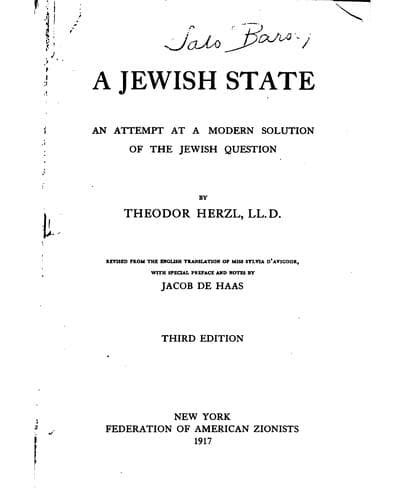
Herzl, Theodor, 1860-1904; Zionism; Zionists -- Austria -- Biography
I said that the Company would build workmen's dwellings cheaply. And
cheaply, not only because of the proximity of abundant building
materials, not only because of the Company's proprietorship of the
sites, but also because of the non-payment of workmen.
American farmers work on the system of mutual assistance in the
construction of houses. This childishly amicable system, which is as
clumsy as the block-houses erected, can be developed on much finer
lines.
UNSKILLED LABORERS
Our unskilled laborers, who will come at first from the great
reservoirs of Russia and Rumania, must, of course, render each other
assistance, in the construction of houses. They will be obliged to
build with wood in the beginning, because iron will not be immediately
available. Later on the original, inadequate, makeshift buildings will
be replaced by superior dwellings.
Our unskilled laborers will first mutually erect these shelters; and
then they will earn their houses as permanent possessions by means of
their work--not immediately, but after three years of good conduct. In
this way we shall secure energetic and able men, and these men will be
practically trained for life by three years of labor under good
discipline.
I said before that the Company would not have to pay these unskilled
laborers. What will they live on?
On the whole, I am opposed to the Truck system,[A] but it will have to
be applied in the case of these first settlers. The Company provides
for them in so many ways, that it may take charge of their
maintenance. In any case the Truck system will be enforced only during
the first few years, and it will benefit the workmen by preventing
their being exploited by small traders, landlords, etc. The Company
will thus make it impossible from the outset for those of our people,
who are perforce hawkers and peddlers here, to reestablish themselves
in the same trades over there. And the Company will also keep back
drunkards and dissolute men. Then will there be no payment of wages at
all during the first period of settlement. Certainly, there will be
wages for overtime.
THE SEVEN-HOUR DAY
The seven-hour day is the regular working day.
This does not imply that wood-cutting, digging, stone-breaking, and a
hundred other daily tasks should only be performed during seven hours.
Indeed not. There will be fourteen hours of labor, work being done in
shifts of three and a half hours. The organization of all this will be
military in character; there will be commands, promotions and
pensions, the means by which these pensions are provided being
explained further on.
A sound man can do a great deal of concentrated work in three and a
half hours. After an interval of the same length of time--which he
will devote to rest, to his family, and to his education under
guidance--he will be quite fresh for work again. Such labor can do
wonders.
The seven-hour day thus implies fourteen hours of joint labor--more
than that cannot be put into a day.
Public-domain text, read in full here on John Shaqi.
Reviews
Reviews
No reviews yet
Be the first to share your thoughts on this work.
Elsewhere in the archive
Join the Discussion
Join the discussion
Sign in to leave a comment or review.
Sign InorCreate an account