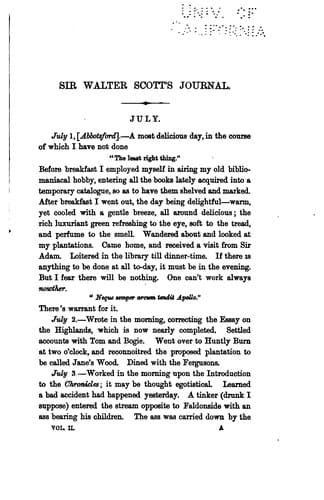
This has been a melancholy day, most melancholy. I am afraid poor
Charles found me weeping. I do not know what other folks feel, but with
me the hysterical passion that impels tears is of terrible violence--a
sort of throttling sensation--then succeeded by a state of dreaming
stupidity, in which I ask if my poor Charlotte can actually be dead. I
think I feel my loss more than at the first blow.
Poor Charles wishes to come back to study here when his term ends at
Oxford. I can see the motive.
_May_ 31.--The melancholy hours of yesterday must not return. To
encourage that dreamy state of incapacity is to resign all authority
over the mind, and I have been wont to say--
"My mind to me a kingdom is."[276]
I am rightful monarch; and, God to aid, I will not be dethroned by any
rebellious passion that may rear its standard against me. Such are
morning thoughts, strong as carle-hemp--says Burns--
"Come, firm Resolve, take thou the van,
Thou stalk of carle-hemp in man."
Charles went by the steam-boat this morning at six. We parted last night
mournfully on both sides. Poor boy, this is his first serious sorrow.
Wrote this morning a Memorial on the Claims which Constable's people
prefer as to the copyrights of _Woodstock_ and _Napoleon_.[277]
FOOTNOTES:
[263] See _Miscellaneous Prose Works_, vol. xx. pp. 152-244, or
_Quarterly Review_ No. 67, Kelly's _Reminiscences_.
[264] 2 _Henry IV_., Act III. Sc. I, slightly altered.
[265] [Mrs. Brown's Lodgings, No. 6 North St. David Street.]
[266] This is the opening couplet of a German trooper's song, alluded to
in _Life_, vol. ii. p. 13. The literal translation is:--
"The day of departure is come;
Heavy lies it on the hearts--heavy."--J.G.L.
[267] Scott had written:--"and yet to part with the companion of twenty
years just six," and had then deleted the three words, "years just six,"
and written "nine" above them. It looks as if he had meant at first to
refer to the change in his fortunes, "just six" MONTHS before, and had
afterwards thought it better to refrain. This would account for a
certain obscurity of meaning.
[268] _As You Like It_, Act II. Sc. 4.
[269] Cicero, _de Orat._ ii. p. 346.--J.G.L.
[270] Walter Scott Lockhart, died at Versailles in 1853, and was buried
in the Cemetery of Notre-Dame there.
[271] The Rev. Edward Bannerman Ramsay, A.M., St. John's College,
Cambridge, incumbent St. John's, Edinburgh, afterwards Dean of the
Diocese in the Scots Episcopal Church, and still more widely known as
the much-loved "Dean Ramsay," author of _Reminiscences of Scottish Life
and Character_. This venerable Scottish gentleman was for many years the
delight of all who had the privilege of knowing him. He died at the age
of eighty-three in his house, 23 Ainslie Place, Edinburgh, Dec. 27th,
1872.
[272] See _Life_, vol. iv. p. 2.
Public-domain text, read in full here on John Shaqi.
Reviews
Reviews
No reviews yet
Be the first to share your thoughts on this work.
Elsewhere in the archive
Join the Discussion
Join the discussion
Sign in to leave a comment or review.
Sign InorCreate an account