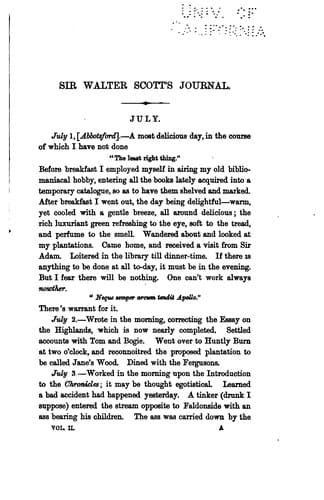
In bounced G. T[homson], alarmed by an anonymous letter, which
acquainted him that thirty tents full of Catholics were coming to
celebrate high mass in the Abbey church; and to consult me on such a
precious document he came prancing about seven at night. I hope to get
him a kirk before he makes any extraordinary explosion of simplicity.
_December_ 29.--Mr. and Mrs. Percival came to-day. He is son of the late
lamented statesman, equally distinguished by talents and integrity. The
son is a clever young man, and has read a good deal; pleasant, too, in
society; but tampers with phrenology, which is unworthy of his father's
son. There is a certain kind of cleverish men, either half educated or
cock-brained by nature, who are attached to that same turnipology. I am
sorry this gentleman should take such whims--sorry even for his name's
sake. Walter and Jane arrived; so our Christmas party thickens. Sir Adam
and Colonel Ferguson dined.
_December_ 30.--Wrote and wrought hard, then went out a drive with Mr.
and Mrs. Percival; and went round by the lake. If my days of good
fortune should ever return I will lay out some pretty rides at
Abbotsford.
Last day of an eventful year; much evil and some good; but especially
the courage to endure what Fortune sends without becoming a pipe for her
fingers.[437]
It is _not_ the last day of the year, but to-morrow being Sunday we hold
our festival of neighbours to-day instead. The Fergusons came _en
masse_, and we had all the usual appliances of mirth and good cheer. Yet
our party, like the chariot-wheels of Pharaoh in the Red Sea, dragged
heavily.
Some of the party grow old and infirm; others thought of the absence of
the hostess, whose reception of her guests was always kind. We did as
well as we could, however.
"It's useless to murmur and pout--
There's no good in making ado;
'Tis well the old year is out,
And time to begin a new."
_December_ 31.--It must be allowed that the regular recurrence of annual
festivals among the same individuals has, as life advances, something in
it that is melancholy. We meet on such occasions like the survivors of
some perilous expedition, wounded and weakened ourselves, and looking
through the diminished ranks of those who remain, while we think of
those who are no more. Or they are like the feasts of the Caribs, in
which they held that the pale and speechless phantoms of the deceased
appeared and mingled with the living. Yet where shall we fly from vain
repining? Or why should we give up the comfort of seeing our friends,
because they can no longer be to us, or we to them, what we once were to
each other?
FOOTNOTES:
Public-domain text, read in full here on John Shaqi.
Reviews
Reviews
No reviews yet
Be the first to share your thoughts on this work.
Elsewhere in the archive
Join the Discussion
Join the discussion
Sign in to leave a comment or review.
Sign InorCreate an account