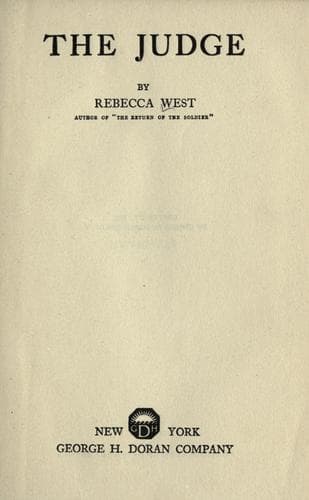
Scotland -- Social life and customs -- 19th century -- Fiction
She must get used to that, because when he was married to Ellen she
would no longer be able to sit up in her bed and call "Richard,
Richard!" and strike the bell that rang in his room--that rang, as it
seemed, in his mind, since no other sound but it ever wakened him in the
night. Not again would he stand at the door, his dark hair damp and
rumpled, his eyes blinking at the strong light, while his voice spoke
hoarsely out of undispersed sleep. "Mother, darling mother, are you
having bad dreams?" Not again would she answer moaningly, "Oh, Richard,
yes!" and tremble with delight in the midst of her agony to see how,
when this big man was dazed and half awake, he held his arms upwards to
her as if he were still a little boy and she a tall overshadowing
presence. In the future he must be left undisturbed to sleep in Ellen's
arms. That thought caused her inexplicable desolation. Rather than think
it she gave up the struggle and allowed herself to be possessed by
memory, and to smart again under the humiliation of that afternoon when
life had made a fool of her. For what had hurt her most was that she had
gone out into the world, the afternoon it stoned her, in a mood of the
tenderest love towards it.
She had risen late, she remembered, that day. All night long she had
been ill, and had not slept until the first wrangling of the birds. Then
suddenly she had opened her eyes, and after remembering, as she always
did when she woke, that she was going to have a child, she had looked
out of her wide window into the mature and undoubtful sunshine of a fine
afternoon. She had felt wonderfully well and terribly hungry, and had
hastened at her washing and dressing so that she could run downstairs
and get something to eat. When she went into the kitchen she saw that
dinner was over, for the plates were drying in the rack and Peggy, the
maid, was not there. It was incredible that she had not known why Peggy
had gone out, that she should fatuously have told herself that the girl
was probably working in the dairy; but in those days her mind was often
half asleep with love for the unborn.
She rejoiced that she had missed the family meal, for it was not easy to
sit at the table with Grandmother and Cousin Tom and Aunt Alphonsine,
unspoken comments on her position hanging from each face like
stalactites. In the larder she found the cold roast beef, magnificently
marbled with veins of fat, and the cherry pie, with its globes of
imperial purple and its dark juice streaked on the surface with richness
exuded from the broken vault-of the pastry, and she ate largely, with
the solemn greed of pregnancy. Afterwards she washed the dishes, in that
state of bland, featureless contentment that comes to one whose being
knows that it is perfectly fulfilling its function and that it is
earning its keep in the universe without having to attempt any
performance on that vexing instrument, the mind.
Public-domain text, read in full here on John Shaqi.
Reviews
Reviews
No reviews yet
Be the first to share your thoughts on this work.
Elsewhere in the archive
Join the Discussion
Join the discussion
Sign in to leave a comment or review.
Sign InorCreate an account