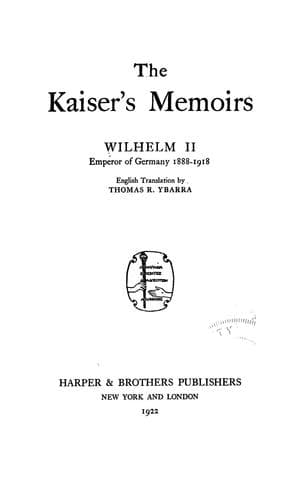
Germany -- Politics and government -- 1888-1918; William II, German Emperor, 1859-1941; World War, 1914-1918
But the gamekeeper shook his head sadly and remarked that he had
already reported all that, but in vain, since the hay for the deer
had to be brought by rail from the Black Sea and the shipments
sometimes either did not arrive at all or were greatly delayed and
arrived spoiled. But nothing would be done to alter this, continued
the gamekeeper, since too many people made a good thing out of this
transporting of the hay, which was paid for at huge prices.
He also told how--after he had called attention to the many splinters
of wood found in the intestines of the deer, in order to prove
that they were insufficiently fed and that feeding places must be
provided--a committee of animal doctors had been brought from St.
Petersburg to investigate the matter. The said committee lived and ate
for weeks in Spala at the Tsar's expense, shot many deer, examined
them, and held sessions; and the upshot of all this was a report that
the animals had wood in their stomachs, which proved that they could
live on wood, for which reason feeding places would be superfluous and
the hay from the Black Sea would suffice to supplement the wood. And
there the matter remained, in spite of Sternburg's visit!
When I heard this yarn, I involuntarily thought of an anecdote which
Prince Bülow especially delighted to tell in connection with his
sojourn at St. Petersburg. While there, he had attended the salon of
Madame Durnovo, where society used often to gather. One day a prominent
general was complaining to the hostess that he had been trapped in a
money matter, which had brought him much unpleasantness from "above."
Apparently he wished, by his mournful description, to arouse sympathy
for his bad luck, but Madame Durnovo retorted, in her rough way: "Mon
cher Général, quand on fait des sâletés, il faut qu'elles réussissent!"
("My dear General, when you play dirty tricks it is necessary that they
be successful!")
As Secretary of State in the Imperial Postal Department likewise, Herr
von Podbielski, after I had chosen him and declined a number of other
candidates, did excellent work, treading worthily in the footsteps of
Stephan. Very practical; endowed with the business sense and a great
knowledge of business; well versed and clever in financial matters; of
innate administrative talent, and, at the same time, quick to fight;
caustically witty; a good speaker and debater--he worked with zeal and
skill, often as a pioneer, particularly in matters of world postal
service, wireless telegraphy, etc. This former colonel in the Ziethen
Hussars made a name for himself in the service of his fatherland which
will never be forgotten.
Public-domain text, read in full here on John Shaqi.
Reviews
Reviews
No reviews yet
Be the first to share your thoughts on this work.
Elsewhere in the archive
Join the Discussion
Join the discussion
Sign in to leave a comment or review.
Sign InorCreate an account