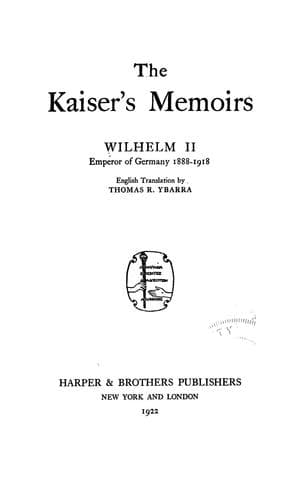
Germany -- Politics and government -- 1888-1918; William II, German Emperor, 1859-1941; World War, 1914-1918
Professor Schiemann enjoyed my particular confidence. An upright man,
a native of the Baltic Provinces, a champion of the Germanic idea
against Slavic arrogance, a clear-sighted politician and brilliant
historian and writer, Schiemann was constantly asked by me for advice
on political and historical questions. To him I owe much good counsel,
especially regarding the East. He was often at my home and often
accompanied me on journeys--as, for instance, to Tangier--and he
heard from me in our talks much important confidential matter not yet
known to others on political questions. His unshakable capacity for
keeping his mouth shut justified my trust in him. It was a source of
satisfaction to me to appoint this tried man curator of the University
of Dorpat, after the liberation of the Baltic Provinces.
KAISER'S RUSSIAN FORESIGHT
How well he and I agreed in our political views regarding Russia is
illustrated by the following incident: After the Peace of Portsmouth,
between Russia and Japan, brought about by me in conjunction with
President Roosevelt in 1905, there was much official (Foreign Office)
and unofficial puzzling of heads at Berlin as to what political line
Russia would take. In general it was thought that Russia, angered at
her defeat, would lean toward the West--and hence toward Germany--in
order to find there new connections and strength to help her in
striking a blow for revenge against Japan and reconquest of her lost
territory and prestige.
My opinion was quite different--but I could not make the official world
share it. I emphasized the following points: That the Russians were
Asiatics and Slavs; being the first, they would be inclined to favor
Japan, in spite of their defeat; being the second, they would like to
ally themselves with those who had proved themselves strong. Hence I
thought that, after a while, Russia, despite the Björkö Agreement,
would join Japan, not Germany, and turn later against Germany.
On account of these "fantastic" ideas, I was actually ridiculed,
officially and unofficially.
I summoned Schiemann and questioned him on this subject, without
revealing to him what I thought about it. I was much pleased when his
answer agreed absolutely with the views held by me. For a long time
Schiemann and I stood almost alone when this weighty matter of foreign
politics came up in discussions.
The event justified us. The so-called "Russian experts" of Berlin, as
well as the official world, were mistaken.
During the very first years of my reign there was occasion for much
important building work.
Public-domain text, read in full here on John Shaqi.
Reviews
Reviews
No reviews yet
Be the first to share your thoughts on this work.
Elsewhere in the archive
Join the Discussion
Join the discussion
Sign in to leave a comment or review.
Sign InorCreate an account