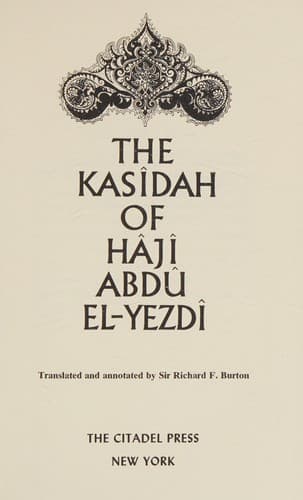
The Kasîdah of Hâjî Abdû El-YezdîBurton, Richard Francis, Sir
Philosophy
The Kasîdah of Hâjî Abdû El-Yezdî
Burton, Richard Francis, Sir
English poetry -- 19th century
The Chain of Universe alludes to the Jain idea that the whole,
consisting of intellectual as well as of natural principles,
existed from all eternity; and that it has been subject to
endless revolutions, whose causes are the inherent powers of
nature, intellectual as well as physical, without the
intervention of a deity. But the Poet ridicules the non-human,
_i.e._, the not-ourselves, the negation of ourselves and
consequently a non-existence. Most Easterns confuse the
contradictories, in which one term stands for something, and the
other for nothing (_e.g._, ourselves and not-ourselves), with the
contraries (_e.g._, rich and not-rich = poor), in which both
terms express a something. So the positive-negative infinite is
not the complement of finite, but its negation. The Western man
derides the process by making not-horse the complementary
entity of horse. The Pilgrim ends with the favourite Soofi
tenet that the five (six?) senses are the doors of all human
knowledge, and that no form of man, incarnation of the deity,
prophet, apostle or sage, has ever produced an idea not conceived
within his brain by the sole operation of these vulgar material
agents. Evidently he is neither spiritualist nor idealist.
He then proceeds to show that man depicts himself in his God, and
that God is the racial expression; a pedagogue on the Nile, an
abstraction in India, and an astrologer in Chaldæa; where
Abraham, says Berosus (Josephus, Ant. I. 7, § 2, and II. 9, § 2)
was skilful in the celestial science. He notices the
Akârana-Zamân (endless Time) of the Guebres, and the working
dual, Hormuzd and Ahriman. He brands the God of the Hebrews with
pugnacity and cruelty. He has heard of the beautiful creations of
Greek fancy which, not attributing a moral nature to the deity,
included Theology in Physics; and which, like Professor Tyndall,
seemed to consider all matter everywhere alive. We have adopted a
very different Unitarianism; Theology, with its one Creator;
Pantheism with its one Spirits plastic stress; and Science
with its one Energy. He is hard upon Christianity and its trinal
God: I have not softened his expression ({Arabic} = a riddle),
although it may offend readers. There is nothing more enigmatical
to the Moslem mind than Christian Trinitarianism: all other
objections they can get over, not this. Nor is he any lover of
Islamism, which, like Christianity, has its ascetic Hebraism and
its Hellenic hedonism; with the world of thought moving between
these two extremes. The former, defined as predominant or
exclusive care for the practice of right, is represented by
Semitic and Arab influence, Korânic and Hadîsic. The latter, the
religion of humanity, a passion for life and light, for culture
and intelligence; for art, poetry and science, is represented in
Islamism by the fondly and impiously-cherished memory of the old
Guebre kings and heroes, beauties, bards and sages. Hence the
mention of Zâl and his son Rostam; of Cyrus and of the
Public-domain text, read in full here on John Shaqi.
Reviews
Reviews
No reviews yet
Be the first to share your thoughts on this work.
Join the Discussion
Join the discussion
Sign in to leave a comment or review.
Sign InorCreate an account