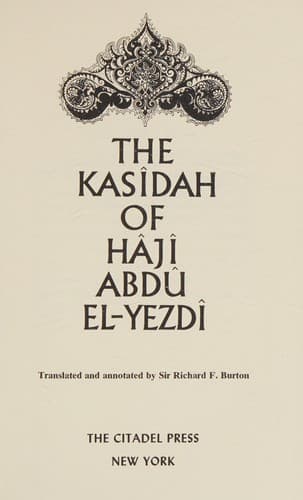
The Kasîdah of Hâjî Abdû El-YezdîBurton, Richard Francis, Sir
Philosophy
The Kasîdah of Hâjî Abdû El-Yezdî
Burton, Richard Francis, Sir
English poetry -- 19th century
Jâm-i-Jamshîd, which may be translated either grail (cup) or
mirror: it showed the whole world within its rim; and hence it
was called Jâm-i-Jehân-numâ (universe-exposing). The contemptuous
expressions about the diet of camels milk and the meat of the
Susmâr, or green lizard, are evidently quoted from Firdausis
famous lines beginning:
Arab-râ be-jâî rasîdest kâr.
The Hâjî is severe upon those who make of the Deity a
Khwân-i-yaghmâ (or tray of plunder) as the Persians phrase it. He
looks upon the shepherds as men,
Who rob the sheep themselves to clothe.
So Schopenhauer (Leben, etc., by Wilhelm Gewinner) furiously
shows how the English nation ought to treat that set of
hypocrites, imposters and money-graspers, the clergy, that
annually devours £3,500,000.
The Hâjî broadly asserts that there is no Good and no Evil in the
absolute sense as man has made them. Here he is one with Pope:
And spite of pride, in erring natures spite
One truth is clearwhatever is, is right.
Unfortunately the converse is just as true:whatever is, is
wrong. Khizr is the Elijah who puzzled Milman. He represents the
Soofi, the Bâtini, while Musâ (Moses) is the Zâhid, the Zâhiri;
and the strange adventures of the twain, invented by the Jews,
have been appropriated by the Moslems. He derides the Freewill of
man; and, like Diderot, he detects pantaloon in a prelate, a
satyr in a president, a pig in a priest, an ostrich in a
minister, and a goose in a chief clerk. He holds to Fortune, the
{Greek: Túxae} of Alcman, which is, {Greek: Eunomías te kaì
Peithoûs adelphà kaì Promatheías thugátaer},Chance, the sister
of Order and Trust, and the daughter of Forethought. The
Scandinavian Spinners of Fate were Urd (the Was, the Past),
Verdandi (the Becoming, or Present), and Skuld (the To-be, or
Future). He alludes to Plato, who made the Demiourgos create the
worlds by the Logos (the Hebrew Dabar) or Creative Word, through
the Æons. These {Greek: Aìwnes} of the Mystics were spiritual
emanations from {Greek: Aìwn}, lit. a wave of influx, an age,
period, or day; hence the Latin _ævum_, and the Welsh Awen, the
stream of inspiration falling upon a bard. Basilides, the
Egypto-Christian, made the Creator evolve seven Æons or Pteromata
(fulnesses); from two of whom, Wisdom and Power, proceeded the
365 degrees of Angels. All were subject to a Prince of Heaven,
called Abraxas, who was himself under guidance of the chief Æon,
Wisdom. Others represent the first Cause to have produced an Æon
or Pure Intelligence; the first a second, and so forth till the
tenth. This was material enough to affect Hyle, which thereby
assumed a spiritual form. Thus the two incompatibles combined in
the Scheme of Creation.
Public-domain text, read in full here on John Shaqi.
Reviews
Reviews
No reviews yet
Be the first to share your thoughts on this work.
Join the Discussion
Join the discussion
Sign in to leave a comment or review.
Sign InorCreate an account