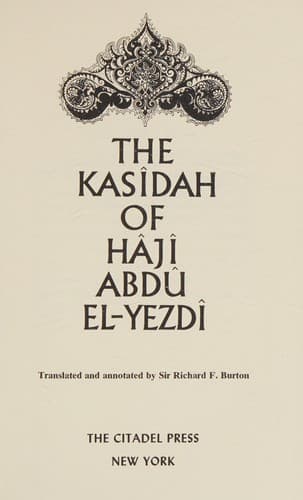
The Kasîdah of Hâjî Abdû El-YezdîBurton, Richard Francis, Sir
Philosophy
The Kasîdah of Hâjî Abdû El-Yezdî
Burton, Richard Francis, Sir
English poetry -- 19th century
Hâjî Abdû evidently holds that idolatry begins with a personal
deity. And let us note that the latter is deliberately denied by
the Thirty-nine Articles. With them God is a Being without
Parts (personality) or Passions. He professes a vague
Agnosticism, and attributes popular faith to the fact that Timor
fecit Deos; every religion being, without exception, the child
of fear and ignorance (Carl Vogt). He now speaks as the Drawer
of the Wine, the Ancient Taverner, the Old Magus, the
Patron of the Mughân or Magians; all titles applied to the
Soofi as opposed to the Zâhid. His idols are the eidola
(illusions) of Bacon, having their foundations in the very
constitution of man, and therefore appropriately called
_fabulæ_. That Natures Common Course is subject to various
interpretation, may be easily proved. Aristotle was as great a
subverter as Alexander; but the quasi-prophetical Stagyrite of
the Dark Ages, who ruled the world till the end of the thirteenth
century, became the twice execrable of Martin Luther; and was
finally abolished by Galileo and Newton. Here I have excised two
stanzas. The first is:
Theories for truths, fable for fact;
system for science vex the thought
Lifes one great lesson you despise
to know that all we know is nought.
This is in fact:
Well didst thou say, Athenas noblest son,
The most we know is nothing can be known.
The next is:
Essence and substance, sequence, cause,
beginning, ending, space and time,
These be the toys of manhoods mind,
at once ridiculous and sublime.
He is not the only one who so regards bothering Time and Space.
A late definition of the infinitely great, viz., that the idea
arises from denying form to any figure; of the infinitely
small, from refusing magnitude to any figure, is a fair specimen
of the dismal sciencemetaphysics.
Another omitted stanza reads:
How canst thou, Phenomen! pretend
the Noumenon to mete and span?
Say which were easier probed and proved,
Absolute Being or mortal man?
One would think that he had read Kant on the Knowable and the
Unknowable, or had heard of the Yankee lady, who could
differentiate between the Finite and the Infinite. It is a
common-place of the age, in the West as well as the East, that
Science is confined to phenomena, and cannot reach the Noumena,
the things themselves. This is the scholastic realism, the
residuum of a bad metaphysic, which deforms the system of
Comte. With all its pretensions, it simply means that there are,
or can be conceived, things in themselves (_i.e._, unrelated to
thought); that we know them to exist; and, at the same time, that
we cannot know what they are. But who dares say cannot? Who can
measure mans work when he shall be as superior to our present
selves as we are to the Cave-man of past time?
Public-domain text, read in full here on John Shaqi.
Reviews
Reviews
No reviews yet
Be the first to share your thoughts on this work.
Join the Discussion
Join the discussion
Sign in to leave a comment or review.
Sign InorCreate an account