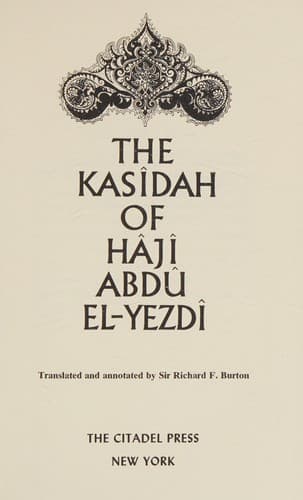
The Kasîdah of Hâjî Abdû El-YezdîBurton, Richard Francis, Sir
Philosophy
The Kasîdah of Hâjî Abdû El-Yezdî
Burton, Richard Francis, Sir
English poetry -- 19th century
He denies the three ages of the Buddhists: the wholly happy; the
happy mixed with misery, and the miserable tinged with
happiness,the present. The Zoroastrians had four, each of 3,000
years. In the first, Hormuzd, the good-god, ruled alone; then
Ahriman, the bad-god, began to rule subserviently: in the third
both ruled equally; and in the last, now current, Ahriman has
gained the day.
Against the popular idea that man has caused the misery of this
world, he cites the ages, when the Old Red Sandstone bred
gigantic cannibal fishes; when the Oolites produced the mighty
reptile tyrants of air, earth, and sea; and when the monsters of
the Eocene and Miocene periods shook the ground with their
ponderous tread. And the world of waters is still a hideous scene
of cruelty, carnage, and destruction.
He declares Conscience to be a geographical and chronological
accident. Thus he answers the modern philosopher whose soul was
overwhelmed by the marvel and the awe of two things, the starry
heaven above and the moral law within. He makes the latter sense
a development of the gregarious and social instincts; and so
travellers have observed that the moral is the last step in
mental progress. His Moors are the savage Dankali and other
negroid tribes, who offer a cup of milk with one hand and stab
with the other. He translates literally the Indian word Hâthî (an
elephant), the animal with the Hâth (hand, or trunk). Finally he
alludes to the age of active volcanoes, the present, which is
merely temporary, the shifting of the Pole, and the spectacle to
be seen from Mushtari, or the planet Jupiter.
The Hâjî again asks the old, old question, What is Truth? And he
answers himself, after the fashion of the wise Emperor of China,
Truth hath not an unchanging name. A modern English writer
says: I have long been convinced by the experience of my life,
as a pioneer of various heterodoxies, which are rapidly becoming
orthodoxies, that nearly all truth is temperamental to us, or
given in the affections and intuitions; and that discussion and
inquiry do little more than feed temperament. Our poet seems to
mean that the Perceptions, when they perceive truly, convey
objective truth, which is universal; whereas the Reflectives and
the Sentiments, the working of the moral region, or the middle
lobe of the phrenologists, supplies only subjective truth,
personal and individual. Thus to one man the axiom, _Opes
irritamenta malorum_, represents a distinct fact; while another
holds wealth to be an incentive for good. Evidently both are
right, according to their lights.
Public-domain text, read in full here on John Shaqi.
Reviews
Reviews
No reviews yet
Be the first to share your thoughts on this work.
Join the Discussion
Join the discussion
Sign in to leave a comment or review.
Sign InorCreate an account