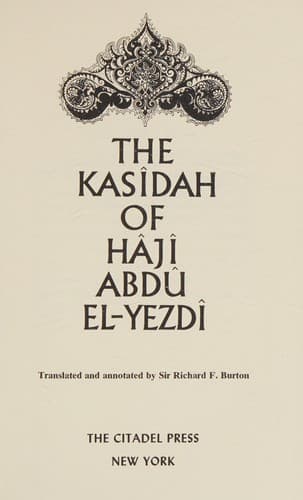
The Kasîdah of Hâjî Abdû El-YezdîBurton, Richard Francis, Sir
Philosophy
The Kasîdah of Hâjî Abdû El-Yezdî
Burton, Richard Francis, Sir
English poetry -- 19th century
Hâjî Abdû cites Plato and Aristotle, as usual with Eastern
songsters, who delight in Mantik (logic). Here he appears to mean
that a false proposition is as real a proposition as one that is
true. Faith moves mountains and Manet immota fides are
evidently quotations. He derides the teaching of the First
Council of the Vatican (cap. v.), all the faithful are little
children listening to the voice of Saint Peter, who is the
Prince of the Apostles. He glances at the fancy of certain
modern physicists, devotion is a definite molecular change in
the convolution of grey pulp. He notices with contumely the
riddle of which Milton speaks so glibly, where the Dialoguists,
reasoned high
Of providence, foreknowledge, will and fate,
Fixed fate, free will, foreknowledge absolute.
In opposition to the orthodox Mohammedan tenets which make Mans
soul his percipient Ego, an entity, a unity, the Soofi considers
it a fancy, opposed to body, which is a fact; at most a state of
things, not a thing; a consensus of faculties whereof our frames
are but the phenomena. This is not contrary to Genesitic legend.
The Hebrew Ruach and Arabic Ruh, now perverted to mean soul or
spirit, simply signify wind or breath, the outward and visible
sign of life. Their later schools are even more explicit. For
that which befalls man befalls beasts; as the one dies, so does
the other; they have all one death; all go unto one place
(Eccles. iii. 19). But the modern soul, a nothing, a string of
negations, a negative in chief, is thus described in the
Mahâbhârat: It is indivisible, inconceivable, inconceptible: it
is eternal, universal, permanent, immovable: it is invisible and
unalterable. Hence the modern spiritualism which, rejecting
materialism, can use only material language.
These, says the Hâjî, are mere sounds. He would not assert Verba
gignunt verba, but Verba gignunt res, a step further. The idea
is Bacons idola fori, omnium molestissima, the twofold
illusions of language; either the names of things that have no
existence in fact, or the names of things whose idea is confused
and ill-defined.
He derives the Soul-idea from the savage ghost which Dr.
Johnson defined to be a kind of shadowy being. He justly
remarks that it arose (perhaps) in Egypt; and was not invented by
the People of the Book. By this term Moslems denote Jews and
Christians who have a recognized revelation, while their
ignorance refuses it to Guebres, Hindus, and Confucians.
Public-domain text, read in full here on John Shaqi.
Reviews
Reviews
No reviews yet
Be the first to share your thoughts on this work.
Join the Discussion
Join the discussion
Sign in to leave a comment or review.
Sign InorCreate an account