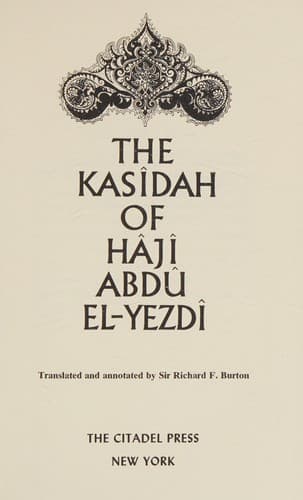
The Kasîdah of Hâjî Abdû El-YezdîBurton, Richard Francis, Sir
Philosophy
The Kasîdah of Hâjî Abdû El-Yezdî
Burton, Richard Francis, Sir
English poetry -- 19th century
Regret, _i.e._, repentance, was one of the forty-two deadly sins
of the Ancient Egyptians. Thou shalt not consume thy heart,
says the Ritual of the Dead, the negative justification of the
soul or ghost (Lepsius Alteste Texte des Todtenbuchs). We have
borrowed competitive examination from the Chinese; and, in these
morbid days of weak introspection and retrospection, we might
learn wisdom from the sturdy old Khemites. When he sings Abjure
the Why and seek the How, he refers to the old Scholastic
difference of the _Demonstratio propter quid_ (why is a thing?),
as opposed to _Demonstratio quia_ (_i.e._ that a thing is). The
great Man shall end with becoming deathless, as Shakespeare
says in his noble sonnet:
And Death once dead, theres no more dying then!
Like the great Pagans, the Hâjî holds that man was born good,
while the Christian, tormented by the things divine, cleaves to
the comforting doctrine of innate sinfulness. Hence the universal
tenet, that man should do good in order to gain by it here or
hereafter; the enlightened selfishness, that says, Act well and
get compound interest in a future state. The allusion to the
Theist-word apparently means that the votaries of a personal
Deity must believe in the absolute foreknowledge of the
Omniscient in particulars as in generals. The Rule of Law
emancipates man; and its exceptions are the gaps left by his
ignorance. The wail over the fallen flower, etc., reminds us of
the Pulambal (Lamentations) of the Anti-Brahminical writer,
Pathira-Giriyâr. The allusion to Mâyâ is from Dâs Kabîr:
Mâyâ mare, na man mare, mar mar gayâ, sarîr.
Illusion dies, the mind dies not though dead and gone
the flesh.
Nirwâna, I have said, is partial extinction by being merged in
the Supreme, not to be confounded with Pari-nirwâna or absolute
annihilation. In the former also, dying gives birth to a new
being, the embodiment of _karma_ (deeds), good and evil, done in
the countless ages of transmigration.
Here ends my share of the work. On the whole it has been
considerable. I have omitted, as has been seen, sundry stanzas,
and I have changed the order of others. The text has nowhere been
translated verbatim; in fact, a familiar European turn has been
given to many sentiments which were judged too Oriental. As the
metre adopted by Hâjî Abdû was the Bahr Tawîl (long verse), I
thought it advisable to preserve that peculiarity, and to fringe
it with the rough, unobtrusive rhyme of the original.
Vive, valeque!
Public-domain text, read in full here on John Shaqi.
Reviews
Reviews
No reviews yet
Be the first to share your thoughts on this work.
Join the Discussion
Join the discussion
Sign in to leave a comment or review.
Sign InorCreate an account